Synesthesia: People Who Taste Words and See Sounds
For some people, the letter A is always red and a C chord looks blue. Synesthesia is real, more common than people think, and runs in families. The types, how it works, and famous synesthetes.
For most people, the senses stay in their own lanes. You hear a song, you see a color, you taste food. For people with synesthesia, the senses cross over. A letter has a color. A sound has a shape. A word has a taste. And it's not imagination or metaphor: it's automatic and consistent, the same every time.
What synesthesia is
Synesthesia (from Greek words meaning "together" and "sensation") is a trait where experiencing one sense, or one kind of thought, automatically triggers another. A person with synesthesia might:
- See the number 7 as green, always.
- See colors when they hear music.
- Taste specific flavors when they hear certain words.
- "Feel" a shape when they taste something.
For most synesthetes, it's not distracting. It's just how the world has always been.
How common is it?
More common than you'd think. A widely cited 2006 study led by psychologist Julia Simner estimated that about 4 percent of people have some form of synesthesia. The most common type, seeing letters or numbers in color, was found in a little over 1 percent.
The most common types
- Grapheme-color: letters and numbers have colors.
- Chromesthesia: sounds, especially music, trigger colors.
- Spatial sequence: numbers, days, or months sit in specific places in space around the person, like a mental map.
- Lexical-gustatory: words trigger tastes. This one is rare.
- Mirror-touch: seeing someone touched creates the feeling of being touched.
It runs in families
Synesthesia often runs in families, which suggests genes play a part. Researchers think it may involve extra connections, or less "pruning" of connections, between brain areas that handle different senses.
How do scientists know it's real?
The test is consistency. If you ask a synesthete what color the letter G is today, and again months later without warning, they give almost exactly the same answer. People asked to make up colors can't do that. Brain imaging has also shown activity in color areas of the brain when some synesthetes see black-and-white letters.
Famous synesthetes
Several well-known artists and musicians have described having synesthesia:
- Billie Eilish and Lorde have both talked about seeing colors with music.
- Pharrell Williams has said he sees colors when he hears music.
- Duke Ellington described hearing notes in colors.
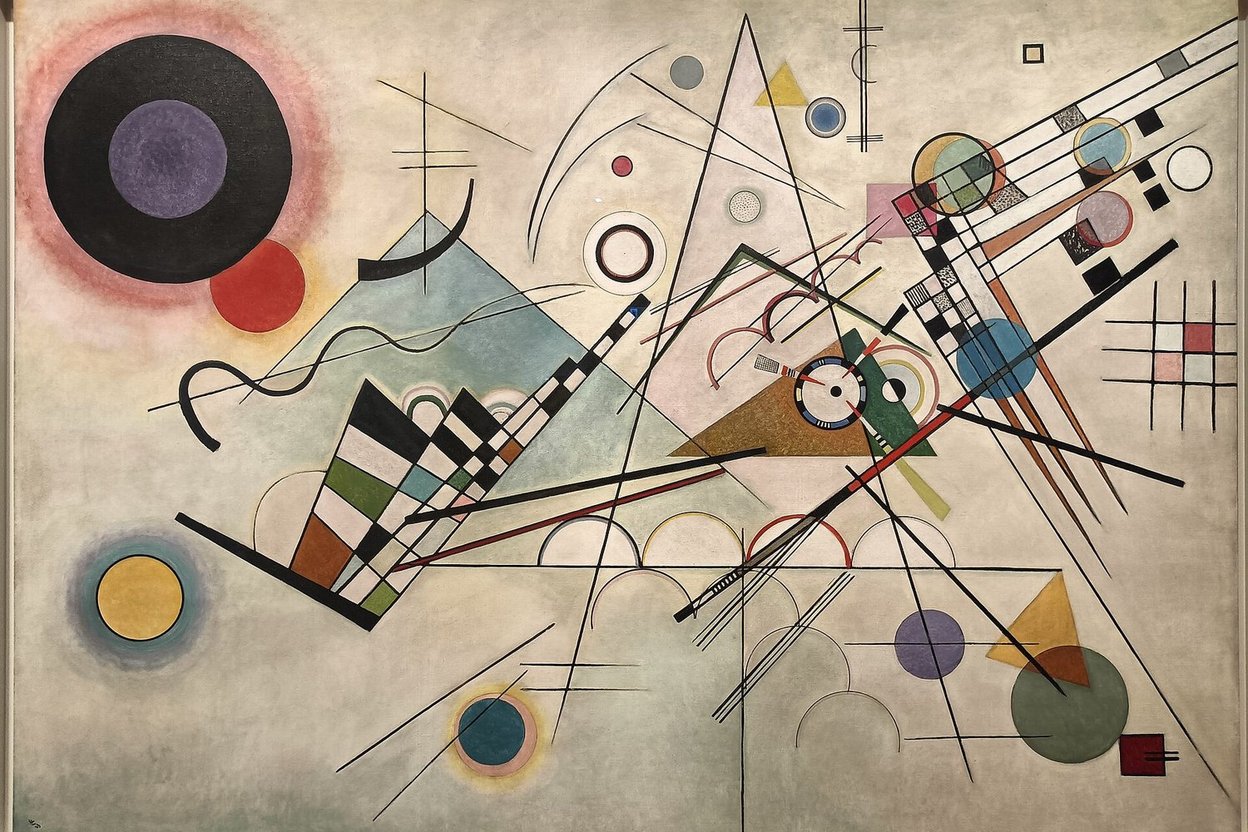
- Wassily Kandinsky, the painter whose work is shown above, is often described as having synesthesia; he wrote about color and sound as deeply connected.
Is it a disorder?
No. Synesthesia isn't a disease and doesn't need treatment. Many synesthetes say it helps them remember things, like phone numbers by their colors.
Do you have it?
If you've always thought of Tuesday as yellow, or 5 as a red number, and you've always assumed everyone did, you might be a synesthete. Researchers have online tests that measure consistency.
For more rare traits, see heterochromia and how rare left-handedness is.
This article is for general information.
Sources (1)
Photo: Kandinsky - Composition 8, July 1923 by Xyxyzyz, CC0.