Where did Chinese checkers come from?
Chinese checkers didn't start in China. See how a Boston surgeon's Halma became a German star board, then an American toy named 'Chinese' in 1928.
Maybe it comes out at Thanksgiving: a star-shaped board, a bag of colored marbles, and a relative who tells you it's an ancient game from China. It isn't. Chinese checkers began in Germany in 1892 as a star-shaped version of Halma, a board game an American surgeon in Boston invented. A New York toy company called it "Chinese" in 1928 to help it sell, and the name stuck.
The short answer
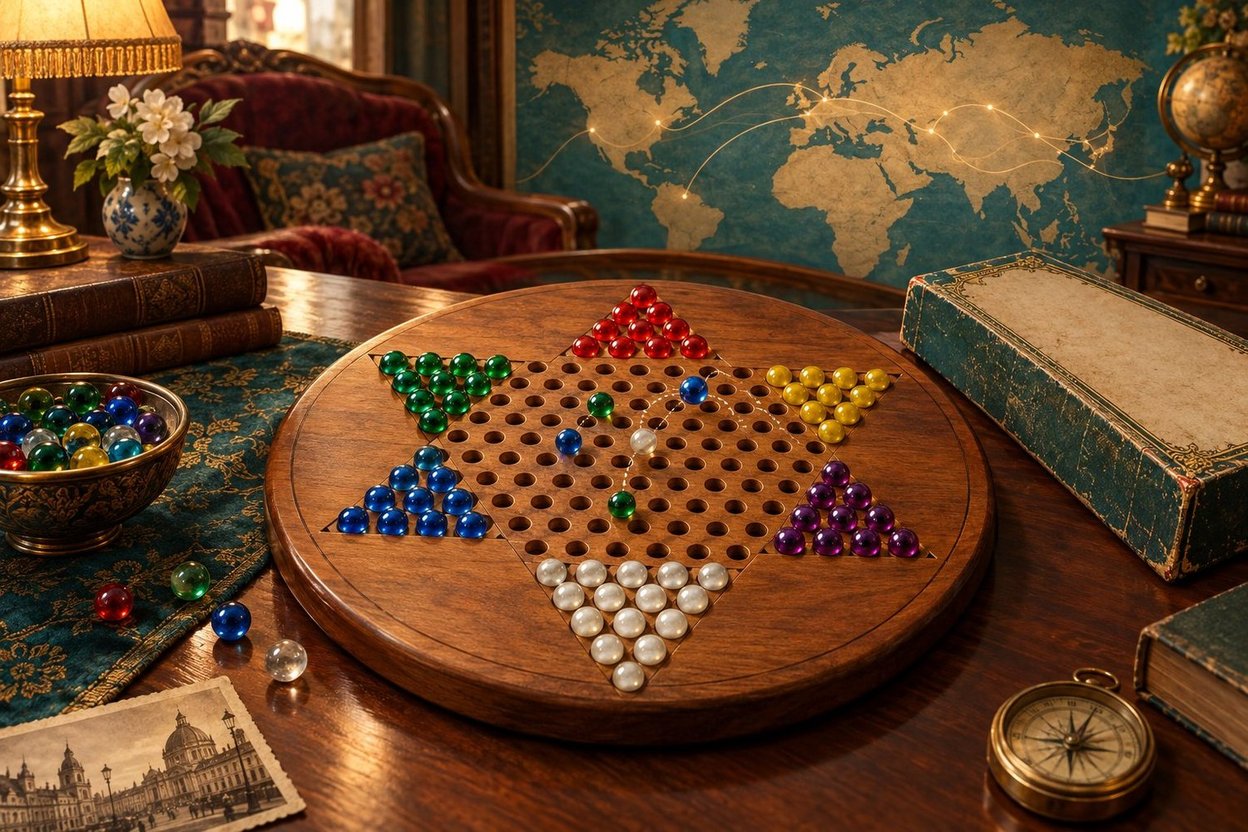
Neither word in the name is true. Wikipedia's Halma article says Chinese checkers has no historical connection to China and isn't a form of checkers. The two games do share one move: you jump over a piece. But in checkers you jump to capture, and in Chinese checkers nothing gets captured. The aim is to move all of your pieces across the board into the point of the star opposite your own.
The game was first published in Germany in 1892 as "Stern-Halma," a variation of an older game called Halma (Wikipedia: Chinese checkers; Traditional Games: Halma). The six-pointed board was the new part. The idea of hopping a team of pieces into an enemy corner came from Halma.
The "Chinese" part came about 36 years later, in the United States. Wikipedia says the name came from a 1928 marketing scheme by Bill and Jack Pressman, and that the game was first sold as "Hop Ching checkers." Almost a century later, most people still believe the label.
So the story starts with the square-board game Halma.
Halma, the grandparent
Halma was invented by George Howard Monks, an American thoracic surgeon at Harvard Medical School, in 1883 or 1884 (Wikipedia: Halma; Traditional Games).
Monks didn't start from scratch. According to Traditional Games, his brother Robert came across a British game called Hoppity on a trip to England in 1883 or 1884. George took "a couple of suggestions" from Hoppity and changed enough to avoid infringing its copyright. Wikipedia dates Hoppity to 1854. That's why Halma is best described as an American invention inspired by an English game.
The name came from someone else. The same Traditional Games page credits Thomas Hill, a mathematician and preacher who later became president of Harvard. Hill suggested "Halma," which the page says is Greek for "jump." For a game built entirely on jumping, it's an accurate name.
Halma is played on a square board, a 16×16 grid. Each player starts with a group of pieces in a corner and races to fill the opposite corner. According to Wikipedia, a two-player game uses 19 pieces per side and a four-player game uses 13 each. The pieces can step to an open square next to them or jump over other pieces, and they can chain several jumps in one turn. Players build "ladders" for their own pieces and try to block their opponents' ladders. Chinese checkers kept all of this.
Monks protected the game legally. Traditional Games reports that he filed patent number 383653 on December 14, 1887, and the patent was issued in May 1888. An early cardboard board published by E.I. Horsman of New York carries the line "Copyrighted 1885," and the games historian Bruce Whitehill believes it may be the earliest edition of the game.
The square board limited how many people could play. Germany fixed that a few years later.
Stern-Halma in Germany
In 1892 the game got a new board: a six-pointed star instead of a square. Traditional Games says the German games company Ravensburger first patented this version, under the name Stern-Halma. The Wikipedia article on Chinese checkers agrees that the game was invented in Germany in 1892 but doesn't name a maker, so the Ravensburger detail has only one source.
"Stern" is German for "star," so the name simply means "star Halma." It was a plain description, not a sales pitch. Germans still call the game Sternhalma today, according to Wikipedia.
The star made the game better. A square has four corners, but a star has six points, so more people can play at once and every player has a home point and a target point. The pieces all cross a shared middle area, where jumps and blocks pile up. This is the game people now know as Chinese checkers, except that it was German and still had a German name.
That changed when the game reached America.
How it became "Chinese"
In 1928, J. Pressman & Co., a New York toy company run by Jack Pressman, published the star game as the "Hop Ching Checker Game" (Traditional Games). Before long, Bill and Jack Pressman renamed it "Chinese Checkers" (Wikipedia: Chinese checkers), and then, as Traditional Games puts it, the game "boomed."
Accounts differ on how the Pressmans got the game. Wikipedia's article on the Pressman Toy Corporation says the company acquired the rights in 1928 after seeing the game on a trip to Colorado. Encyclopedia.com also describes the Pressman game as a version of Halma with no connection to China, and it calls the game the company's first major success. In any version of the story, the Pressmans didn't invent the game. They gave it a new name and sold it very well.
Why "Chinese"? Wikipedia says the game was renamed for the American market to sound more exotic. In the 1920s, "Chinese" on a box suggested something old and far away, which a German name didn't. Adding "checkers" told American shoppers it was a jumping game they could learn quickly. Neither word described where the game came from, but together they sold it.
Other companies copied the game, and the name spread with their versions. According to Traditional Games, Milton Bradley "somehow managed to obtain rights to the name in 1941." The same page says this "didn't seem to affect anything," and the game kept being sold under the same name by many makers. That account comes from one source, and other sources give different details, so the exact year and the legal form of those rights are uncertain.
The name has lasted for almost a century. China later adopted the game, but under a name of its own.
The game today
Outside the United States, the game mostly goes by names that describe how it's played. In China it's called tiaoqi (跳棋), which means "jump game" (Wikipedia: Chinese checkers). That's close to what "Halma" meant. Japan has a variant called the "diamond game" with slightly different rules. Germany still uses Sternhalma.
The rules are the same everywhere. According to Wikipedia:
- Players: two, three, four or six. Five can't play, because one player would have no opponent in the opposite point and the game would be unbalanced.
- Pieces: usually 10 per player, placed in that player's point of the star.
- Goal: be the first to move all of your pieces into the opposite point by single steps and chains of jumps.
- Board: Wikipedia describes the 15-piece diamond game as using "the same board as in Chinese checkers, with 121 spaces," which makes 121 the usual count for a standard board.
If you get the board out over the holidays this year, you'll know the real story: a Boston surgeon's game called "jump," a German star-shaped board, and an American toy company's name.