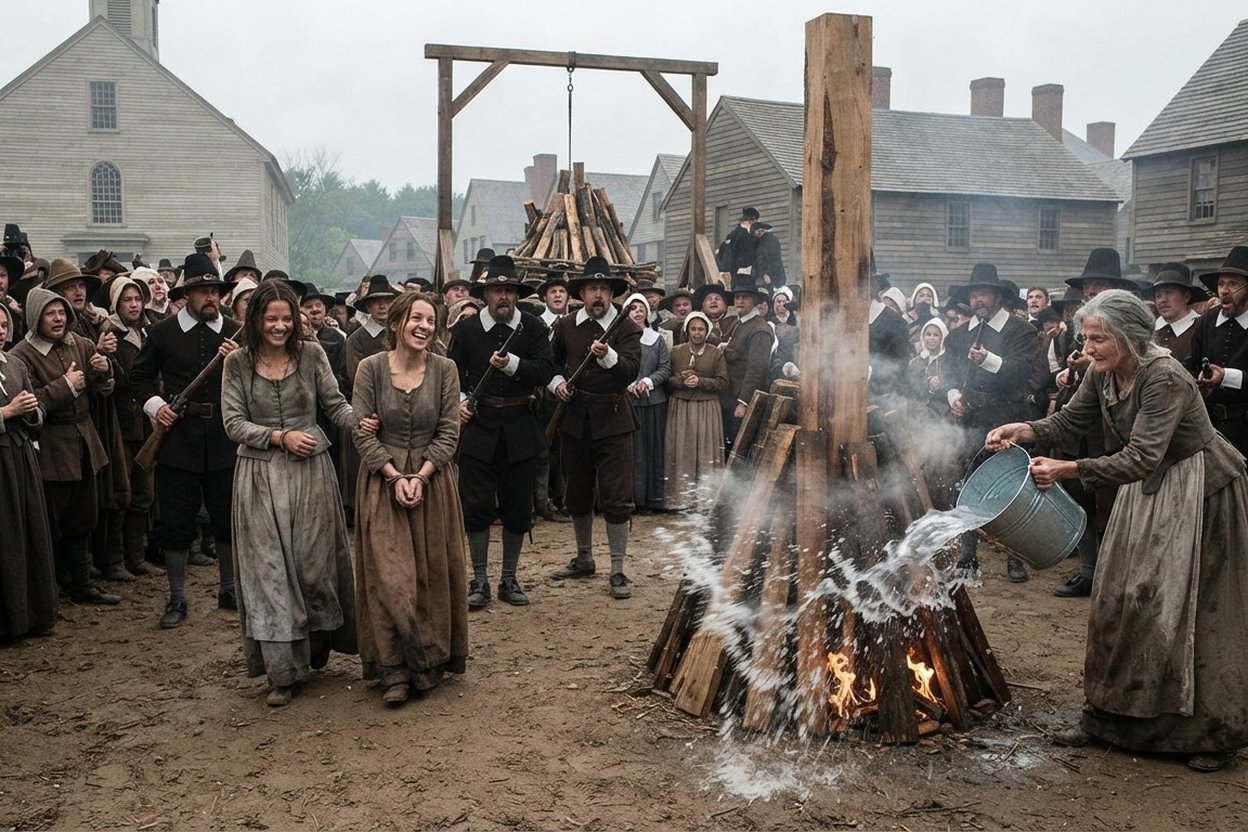
Nobody Was Burned at Salem. Here's How the "Witches" Actually Died
Discover what really happened to the accused witches in Salem. The 1692 trials ended in 20 executions—but not by fire.
Every October the same picture comes back: a witch hat in a store window, a costume party, a movie where a crowd ties a woman to a stake and lights the pile under her. If you grew up with that picture, you've probably assumed that's what happened in Salem. It didn't. Nobody accused of witchcraft in Salem in 1692 was burned. Nineteen people were hanged, one man was crushed under heavy stones, and several more died in jail before their cases were settled.
The short answer
No one was burned at the stake in Salem. History.com and Live Science both say so directly. The 1692 trials ended in 20 executions: 19 people hanged and one man, Giles Corey, pressed to death.
The difference matters because the punishment came from a particular legal system. Massachusetts was an English colony, and in England and its colonies witchcraft was tried as a crime in the criminal courts. People convicted of capital crimes there were hanged. Burning was the punishment in other places, under other laws.
The executions weren't the only deaths. People accused of witchcraft were held for months in crowded, unhealthy jails, and some died there without ever being tried or released. So the full death toll depends on how you count. Every version agrees on one point: none of the deaths were by fire.
The real story is grim in its own way, and the details explain why the burning image stuck to Salem anyway.
Who died and how
The hangings took place on four days in 1692, according to The Collector's account of the trials:
- June 10: Bridget Bishop, the first person executed.
- July 19: Five women: Sarah Good, Rebecca Nurse, Elizabeth Howe, Susannah Martin and Sarah Wildes.
- August 19: Five people: Rev. George Burroughs, George Jacobs Sr., Martha Carrier, John Proctor and John Willard.
- September 22: The last eight: Martha Corey, Mary Eastey, Mary Parker, Alice Parker, Ann Pudeator, Wilmot Redd, Margaret Scott and Samuel Wardwell.
Giles Corey died a few days before that last hanging. He was about 81, and he refused to enter a plea. Without a plea the court could not try him, so under English practice he was pressed with heavy stones. The Library of Congress Law Library dates his death to between September 17 and 19, 1692. Some historians think he went through it to protect his property, because a convicted felon forfeited his estate to the government. The Law Library notes that this explanation has been challenged. Corey had also said the court had already decided he was guilty.
According to The Collector, at least five more accused people died in jail: Sarah Osborne, Roger Toothaker, Rebecca Chamberlain, Ann Foster and Lydia Dustin. Dustin died in March 1693. That brings the total to 25 deaths, though sources count the jail deaths differently, so totals vary. The figure of 19 hanged plus Corey is consistent across the sources.
Why hanging and not fire
Courts in different places burned or hanged witches depending on what kind of offense they took witchcraft to be.
In England, the Act against Witchcraft of 1604 made witchcraft a felony punishable by death. As Mental Floss points out, the act never mentions fire. Felons in England were hanged, so English witches were hanged.
Massachusetts was founded under England's legal framework and kept it. When the Salem court sentenced people to death, it used the standard English punishment for a felony, which was the rope. History.com and Mental Floss both explain the Salem hangings this way.
Scotland and much of continental Europe saw it differently. There, witchcraft was treated as heresy, a crime against God and the church, and heretics were burned. Live Science describes the same split. A witch convicted in Edinburgh or in parts of the German lands could face the fire. A witch convicted in Essex, England, or Essex County, Massachusetts, faced the gallows.
Fire wasn't completely unknown in colonial Massachusetts. Live Science reports that an enslaved woman named Maria was burned there in 1681, more than a decade before the trials. Her case was not a witchcraft case and did not take place in Salem. Massachusetts law allowed burning for some offenses, but witchcraft was not one of them.
Where the myth comes from
The burning image has real history behind it. It just happened in Europe, not Salem.
According to History.com, historians estimate that about 50,000 people were executed as witches in Europe between the 15th and 18th centuries, and many of them were burned. In the Holy Roman Empire the law code known as the Constitutio Criminalis Carolina set fire as the punishment for harmful witchcraft. Those European witch hunts were far larger than anything in New England. Salem's 20 executions are a small fraction of that estimated total.
Even the Scottish burnings were often not what the movies show. Mental Floss cites a University of Edinburgh study of 141 Scottish cases. In about 120 of them, the accused was strangled at the stake first and the body burned afterward. They were not burned alive.
Over time, pop culture merged all of this into one image. Salem is the best-known witch trial in America, and the burning stake is the best-known image of witch hunts in general. Halloween decorations, films and cartoons combined the two, and many people now picture Salem with flames.
Where it happened, and how it ended
For a long time, many people believed the hangings took place at the top of Gallows Hill in Salem, and the name is still commonly used. In January 2016, a research team confirmed that the actual site was Proctor's Ledge, a rocky spot near the bottom of the hill. The team found that there probably never was a built gallows. The executioners likely threw a rope over a large tree. The researchers found no evidence that anyone was buried at the site.
The city dedicated a memorial at Proctor's Ledge on July 19, 2017, 325 years to the day after five women were hanged there. It was designed by Martha Lyon. The site is a quiet stone wall in a neighborhood, and it gets far fewer visitors than Salem's October attractions.
The legal cleanup took even longer. On May 26, 2022, Massachusetts lawmakers exonerated Elizabeth Johnson Jr., who had been convicted in 1693 and never executed. She was the last person convicted in the trials whose name had not been cleared, 329 years after her conviction. An eighth-grade class at North Andover Middle School led the push to clear her.
If someone brings up a Salem burning at a Halloween party this year, you can correct them: the rope, the stones and the jails killed people at Salem, and nobody was burned.
Sources (11)
- History.com: Were Witches Burned at the Stake During the Salem Witch Trials?
- Live Science: How were the Salem 'witches' executed?
- Mental Floss: Why English law hanged witches and Scottish law burned them
- Library of Congress, In Custodia Legis: The Crushing Death of Giles Corey of Salem, 1692
- The Collector: How Many Died in the Salem Witch Trials?
- Salem Witch Museum: Proctor's Ledge
- University of Virginia IATH: Salem hanging site confirmed (2016)
- ABC13: Researchers confirm site of hangings for Salem witch trials
- History of Massachusetts: Proctor's Ledge Memorial
- GBH News: After 329 years, a woman accused of being a witch in Salem has been exonerated
- Bangor Daily News: Last Salem witch posthumously pardoned 329 years later