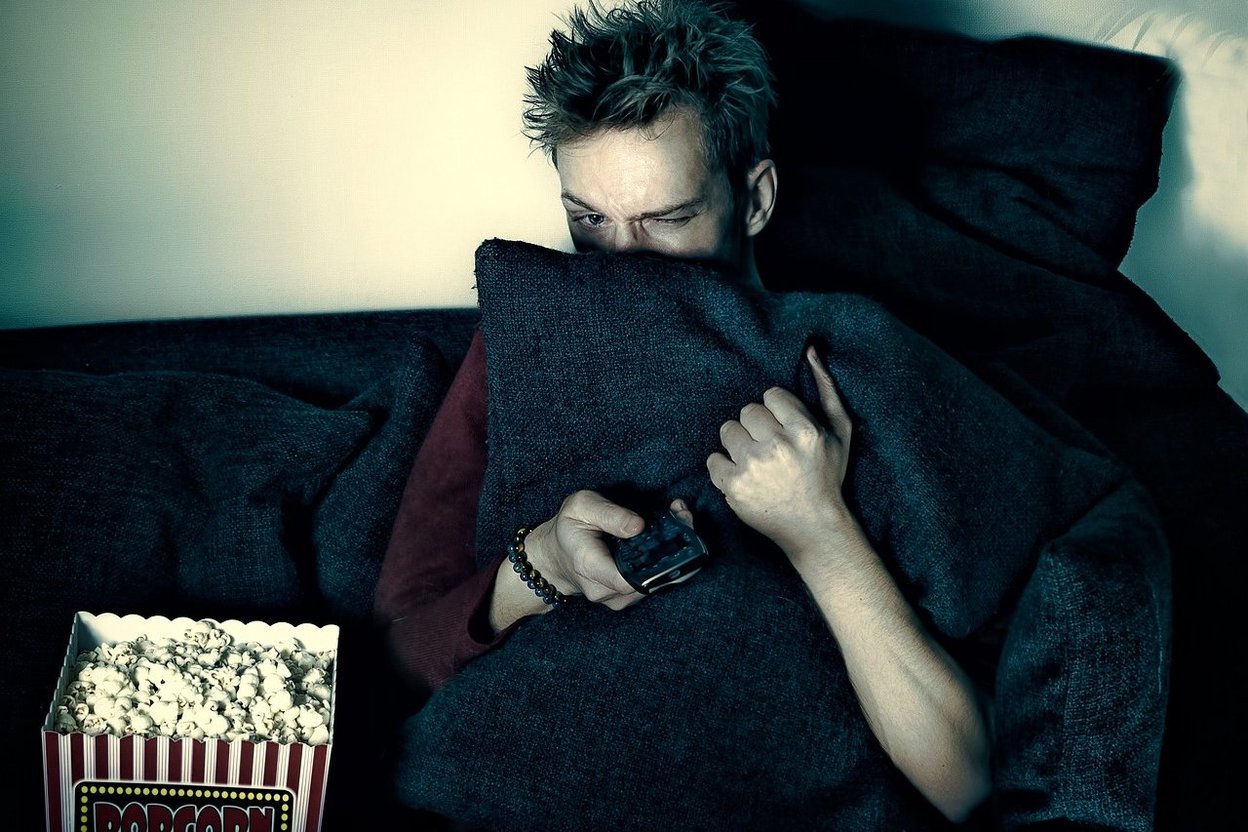
Why Some People Love Being Scared: The Science of Haunted Houses and Horror Movies
What haunted house and horror movie studies found about why fear feels fun, the fear sweet spot, and the three kinds of horror fans.
Some people love being scared because the fear is real in the body but fake in the situation. Your heart races, your skin sweats and your brain fires its alarm system, while part of you knows the chainsaw has no chain. Researchers who wired people up inside haunted houses found that a moderate scare gives the most fun, and that many visitors walk out in a better mood than they walked in.
That isn't true for everybody, and the studies are small. But in the last few years scientists have taken heart rate monitors, brain scanners and EEG headsets into haunted attractions and movie theaters, and the results explain a lot about why October sells so many tickets.
What fear does to your body
A jump scare sets off the fight-or-flight response. Adrenaline goes up, your heart rate climbs, your breathing speeds up and your muscles get ready to move. Your skin sweats slightly, which is why researchers often measure skin conductance as a fear gauge.
In a dark hallway with an actor lunging at you, all of that happens in about the same way it would in real danger. The difference is what comes after. Your brain checks the situation, sees a teenager in a mask and a fire exit sign, and calls off the emergency. You get the rush and then the relief, back to back.
What brain scans show during horror movies
In 2020, researchers at the University of Turku in Finland published a study in NeuroImage on how horror films work on the brain. They first built a list of the best horror movies of the past 100 years using IMDb ratings and a survey of 216 horror fans. Then they put 37 volunteers in an MRI scanner and played The Conjuring 2 and Insidious.
The two kinds of scares showed up differently on the scans:
- Slow-building dread mostly raised activity in the brain areas that handle sight and sound. Your brain was watching and listening harder, looking for the threat.
- Sudden jump scares lit up the brainstem, thalamus, amygdala and cingulate cortex, areas tied to threat detection, emotion and deciding what to do next.
The volunteers also said the scariest horror was psychological, based on real events, or about things that were hinted at instead of shown. A monster you can't see works harder on you than one in full view.
The haunted house "sweet spot"
The best-known haunted house study came out of Aarhus University in Denmark, home of the Recreational Fear Lab. Lead author Marc Malmdorf Andersen and his team fitted 110 visitors with heart rate monitors and sent them through a commercial haunted attraction in Vejle, Denmark, with nearly 50 rooms of scares. Cameras recorded their reactions, and afterward everyone rated each scare for fear and fun.
When the team plotted fear against enjoyment, they got an upside-down U. People who weren't very scared didn't enjoy it much. People who were terrified didn't enjoy it much either. The most fun was in the middle.
The heart rate data matched. Short, "just-right" jumps away from a person's normal heart rate went with the most enjoyment. Large, long-lasting spikes went with a bad time. The study was published in Psychological Science in 2020, and the authors compared it to play in general: we seek out a measured dose of surprise and uncertainty, the same way kids like being chased.
The sweet spot is different for each person. That's why one friend laughs through a haunted house while another leaves through the chicken exit in room three.
Many people feel better afterward
Sociologist Margee Kerr, working with Greg Siegle of the University of Pittsburgh and Jahala Orsini of UPMC, ran a study at ScareHouse, an intense haunted attraction in Pittsburgh. They surveyed 262 adults who had bought tickets and hadn't been through before, asking about mood before and after. One hundred of them also wore portable EEG headsets.
What they found, published in the journal Emotion in 2019:
- Most visitors said they enjoyed it and came out in a better mood.
- People who walked in stressed, bored or tired improved the most.
- Many said they felt they had challenged their fears and learned something about themselves.
- The EEG showed reduced brain activity across several areas after the attraction, most in the people who reported the biggest benefit.
The researchers' take was that a big, safe scare can act like a reset. That fits what a lot of people say about a haunted house: you come out laughing, a little shaky, and calmer than you've felt all week. Keep in mind the people in the study had already paid to be scared, so they were not a random sample.
Your friends make it scarier
You'd think going with friends would calm you down. A 2022 study at The 17th Door, an immersive haunted house in Fullerton, California, found the opposite. Psychologist Sarah Tashjian and colleagues measured skin conductance in 156 adults and found stronger fear responses when people went through with friends. With strangers, the fear response was weaker.
Tashjian's explanation was a feedback loop: friends feed off each other's screams and laughs, and the whole group gets more wound up. If you want the full haunted house experience, bring the friend who screams the loudest.
The three kinds of horror fans
The Aarhus researchers later sorted horror fans into three types, and most people will recognize themselves in one:
- Adrenaline junkies go for the rush. They lean into the scares, let themselves scream and walk out in a better mood.
- White-knucklers are truly afraid and may even get nightmares, but they keep going. They tend to calm themselves down during the scares, and they report a sense of personal growth afterward.
- Dark copers use horror to deal with stress or anxiety in their own lives. They reported both the fun and the growth.
None of these is the "right" way to be a horror fan. They just get different things out of the same movie.
Horror fans and the pandemic
In 2021, Coltan Scrivner, then at the University of Chicago, published a study with Aarhus researchers in Personality and Individual Differences. They surveyed more than 300 people early in the COVID-19 pandemic.
Horror fans reported fewer signs of psychological distress than non-fans. Fans of "prepper" movies (zombies, alien invasions, end-of-the-world stories) showed more resilience and said they were better prepared. People high in morbid curiosity were also more resilient.
The idea behind it: scary fiction lets you practice dealing with fear when nothing is really at stake. It's a survey, so it shows a link, not proof that horror movies make you tougher. People who are already resilient might simply like horror more.
Why some people hate it
If you can't stand horror, nothing is wrong with you. Everyone's sweet spot is in a different place, and for some people even a mild scare lands on the wrong side of the curve. Your heart rate jumps and stays up, and what's a thrill to your friend just feels bad to you.
People also differ in how much they like intense, new experiences in general, which psychologists call sensation seeking. High sensation seekers tend to like roller coasters, spicy food and horror. Low sensation seekers would rather skip all three. The same body reaction can feel like fun to one person and like danger to another.
The true danger stories are different, by the way. When the threat is real, the same adrenaline system can do remarkable things, like the cases in our piece on hysterical strength.
How to find your own sweet spot this Halloween
- Start in the middle. Try a mid-level haunted house or a suspense movie before the most extreme one.
- Pick your group on purpose. Go with friends if you want it scarier, with fewer or quieter people if you want it milder.
- Notice when fun turns into dread. If your heart is still pounding long after the scare and you're not laughing, you've gone past your peak. Use the exit.
- For movies, choose your fear type. Jump scares give quick spikes. Slow-burn psychological horror builds dread over time. Many people can handle one much better than the other.
- Want laughs mixed in? Plenty of comedians have made horror movies. See our list of comedians who made horror movies.
The one thing to remember: the fun comes from being scared enough, not as scared as possible.
Sources (6)
- Haunted house researchers investigate the mystery of playing with fear (ScienceDaily, 2020)
- Playing With Fear: A Field Study in Recreational Horror (Psychological Science)
- Why Do People Like to Be Scared? (Psychology Today, on the ScareHouse study)
- Horror movies manipulate brain activity expertly to enhance excitement (University of Turku)
- At a Haunted House, Friends Heighten the Terror (Scientific American)
- How 3 Types of Fans Benefit from Horror (Psychology Today)
Photo by Sammy-Sander on Pixabay.