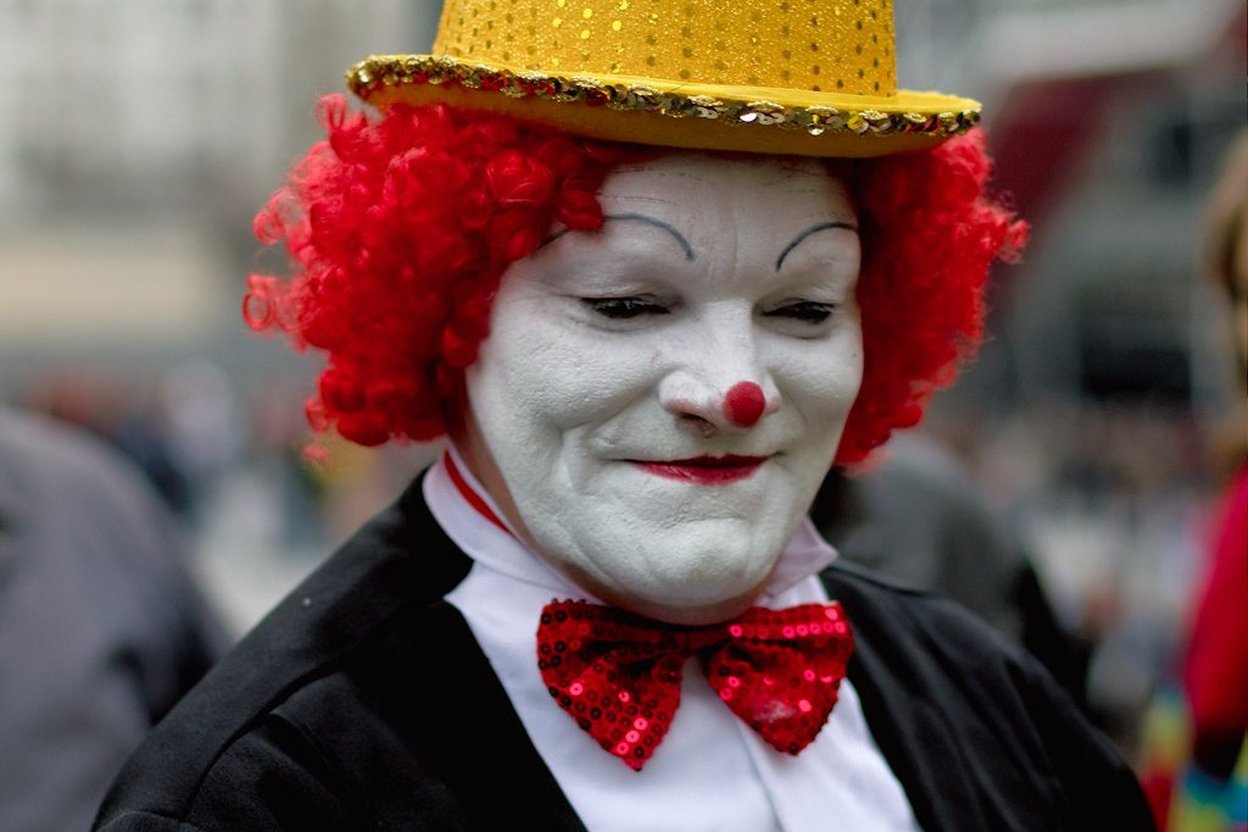
The Fear of Clowns: What Research Has Measured
Learn what research actually measures about fear of clowns, from the largest survey to national polls, plus when it becomes a clinical phobia.
You're walking through a Halloween pop-up store, and at the end of an aisle a rubber clown mask stares back with a painted grin that doesn't move. If your stomach tightens, you're far from the only one. How many people feel that way depends on who is asked and how. In the largest survey built around clowns, just over half of respondents said they were at least slightly afraid, but only about 5% said they were extremely afraid. National polls of U.S. adults find much smaller shares. A clinical phobia is something narrower than either number.
What the largest study counted
The biggest study so far came from researchers at the University of South Wales. Their online survey ran from 16 September to 31 December 2019 and spread by people sharing it on social media and university forums. Researchers call this a convenience or "snowball" sample. After cleaning, 987 adults remained out of 1,023 who completed it. The group was 790 women (80%) and 197 men (20%), aged 18 to 77 with a mean age of about 30, and born in 64 countries. The largest group, 598 people, was born in the United Kingdom. The data from this one survey went into two papers: a prevalence paper in 2022 and an origins paper in 2023.
The survey asked two questions, and they produced different results:
- "Do you have a fear of clowns?" 272 people (27.6%) said yes. Women said yes more often than men: 29.6% versus 19.3%.
- "How afraid are you of clowns?" 46.5% said not at all, 34.2% slightly or somewhat, 14.2% moderately and 5.1% extremely.
Counting everyone who was at least slightly afraid gives 53.5%, or 528 people. That's the source of the "most adults fear clowns" claim. "Extremely afraid" covered 5.4% of the women and 3.6% of the men.
Participants also completed an 18-item Fear of Clowns Questionnaire, adapted from a questionnaire about fear of spiders. Women scored higher on it, with a mean total of 43.68 against 36.10 for men out of a possible 126. Scores fell slightly with age, but the correlation was weak (r = −.104). The questionnaire measures how strong the fear is. It doesn't diagnose anything. The authors say the female-heavy sample limits how far the results can be generalized.
What those respondents said was behind the fear
The origins paper looked only at the 528 people who were at least slightly afraid: 450 women and 78 men from 52 countries. They rated eight proposed explanations from 1 (totally disagree) to 7 (totally agree). The average ratings were:
- Makeup hides real emotional signals: 5.20
- Negative portrayals in media: 5.03
- Unpredictable behavior: 4.96
- An uncanny, not-quite-human look: 4.78
- A direct sense of threat: 3.99
- Disgust, or a reminder of death, infection or blood: 3.40
- Learning the fear from family or friends: 2.78
- A frightening personal experience with a clown: 2.65
The explanation people agreed with most was that face paint makes it hard to read what a clown is feeling or intending. A bad personal encounter came last, even though it's the explanation people often assume. Learning the fear from relatives ranked near the bottom too. No study here measured whether genes play a role.
Men and women ranked the causes in much the same way, with no statistically significant differences. Only one age link held up after statistical correction: older people in the afraid group gave hidden emotions a slightly higher rating (r = 0.152).
The authors use Stephen King's 1986 novel It, the wider killer-clown genre and the real murderer John Wayne Gacy as examples of the cultural background. They didn't test any of these as causes. They also point out that some people fear Ronald McDonald, a character never meant to be scary. In their view, that suggests a clown's appearance matters on its own, apart from horror stories. They give no figure for how many people fear him.
When unease counts as a phobia, and where the name comes from
The word "coulrophobia" is newer than many people think. Merriam-Webster dates its first known use to 1998 and says the "coulro-" part is of unknown origin. A suggested link to a rare Greek word for stilt-walker is, in the dictionary's view, too far from the English word's sound to be plausible. A 2020 column in The BMJ reports that the Oxford English Dictionary also lists the origin as unknown and treats the stilt-walker idea as unlikely.
Psychiatry doesn't treat it as a separate condition either. Cleveland Clinic notes that the DSM doesn't list coulrophobia as its own disorder and has no diagnostic criteria for it. The South Wales authors place clowns and costumed characters in the "other" subtype of specific phobia, which they say the DSM has said little about.
Under the DSM-5-TR, as summarized by the Merck Manual, a fear of clowns would count as a specific phobia only if it met all of these conditions:
- marked fear lasting at least six months
- clowns almost always causing immediate fear
- the person actively avoiding them
- fear out of proportion to the actual danger
- real distress, or problems in social or work life
Most people with a specific phobia know their fear is excessive. Specific phobias of all kinds are common. NIMH estimates that 9.1% of U.S. adults had one in the past year, but that figure covers every type of phobia, not just clowns.
What probability samples of U.S. adults found
Polls that randomly select national samples, rather than relying on people sharing a survey, find much lower numbers:
- Chapman University's Survey of American Fears, 2018: 7.1% of Americans were afraid or very afraid of clowns.
- Chapman, 2019: of 1,219 adults on a probability panel, 3.0% were very afraid, 5.2% afraid and 8.9% slightly afraid. That's 8.2% afraid or very afraid, and 17.1% with any fear at all. The other 82.8% were not afraid.
- Chapman, 2020/21: of 1,035 adults surveyed in January 2021, 5.6% were afraid or very afraid. Clowns ranked 94th of the 95 fears on the list.
- YouGov, 2014: in a survey of 1,000 Americans, clowns were the least-feared item asked about. 13% were at least a little afraid and 5% were very afraid.
- YouGov, 2022: asked to choose every item they fear, 7% of 1,000 adults picked clowns. That included 5% of men and 8% of women, and 13% of 18- to 29-year-olds compared with 2% of people 65 and older.
Timing can affect the results. A Vox/Morning Consult poll in October 2016, during a wave of reported clown sightings, found 42% afraid "in some capacity," a figure that counted people who were only "a little" afraid. None of these poll questions is a diagnosis. They measure how people describe their feelings, not whether anyone meets the criteria above.
What studies of children and hospital clowns measured
Research on children has mostly focused on medical clowns who visit hospital wards. According to the South Wales team's review, 1% to 6% of children in those studies showed apprehension.
- Meiri and colleagues (2017): 14 of 1,160 hospitalized children aged 1 to 15 (1.2%) showed fear of a clown visit. Fear was judged from what the child said or from crying, anxiety or avoidance. Twelve of the 14 were girls, and six cases were called severe. The review gives a mean age of 3.5 for this group.
- Barkmann and colleagues (2013): about 1% of children refused a medical clown because of fear.
- Glasper and colleagues (2007): 3 of 49 children expressed a dislike of clowns. So did 8 of 43 parents, 6 of 13 doctors and 22 of 93 other staff.
The adult figures in these studies describe dislike in very small groups, not rates of fear. The reviewers themselves say the methods weren't rigorous.
Medical-clown programs have largely succeeded at reducing children's fear and anxiety about hospital care, with a minority of children, parents and staff reacting badly. One separate finding involves decor rather than visits: a U.K. hospital left clowns out of its new pediatric decor after the children it consulted said the images were scary.
What treatment research has measured
No study covered here tested a treatment designed specifically for fear of clowns. Cleveland Clinic states that there is no separate coulrophobia treatment. The evidence comes from research on specific phobias in general. Merck describes exposure therapy, meaning gradual, guided contact with the feared thing, as the most studied and most effective approach. It is more effective than no treatment for about 85% of patients. Medication such as a short-acting anti-anxiety drug is sometimes used for unavoidable situations but isn't the main treatment.
Disliking the costumes in this month's Halloween aisles doesn't make a fear a phobia. Going by the diagnostic rules above, it becomes one only when it has lasted six months or more, leads to active avoidance and gets in the way of work, social life or daily routines.
Sources (16)
- Tyson et al., Prevalence of Fear of Clowns (University of South Wales, 2022 proof)
- International Journal of Mental Health, prevalence paper
- Frontiers in Psychology, origins paper (2023)
- Scientific American, The Weird Reason We're Afraid of Clowns
- Merriam-Webster, coulrophobia
- The BMJ blog, Jeffrey Aronson: When I use a word… Clowns
- Cleveland Clinic, Coulrophobia
- Merck Manual Professional, Specific Phobias
- NIMH, Specific Phobia statistics
- Chapman University, 2019 survey methodology
- Chapman University, Wave 7 methodology report
- Chapman University, America's Top Fears 2020/21
- Chapman University, Complete Fears 2018
- YouGov, Argh, snakes! (2014)
- YouGov, Phobias tabs (2022)
- Vox, Clown scare sightings 2016