Amber Eyes and "Wolf Eyes" Explained
What makes amber eyes golden, how they differ from hazel, how rare they are, and why people call them wolf eyes.
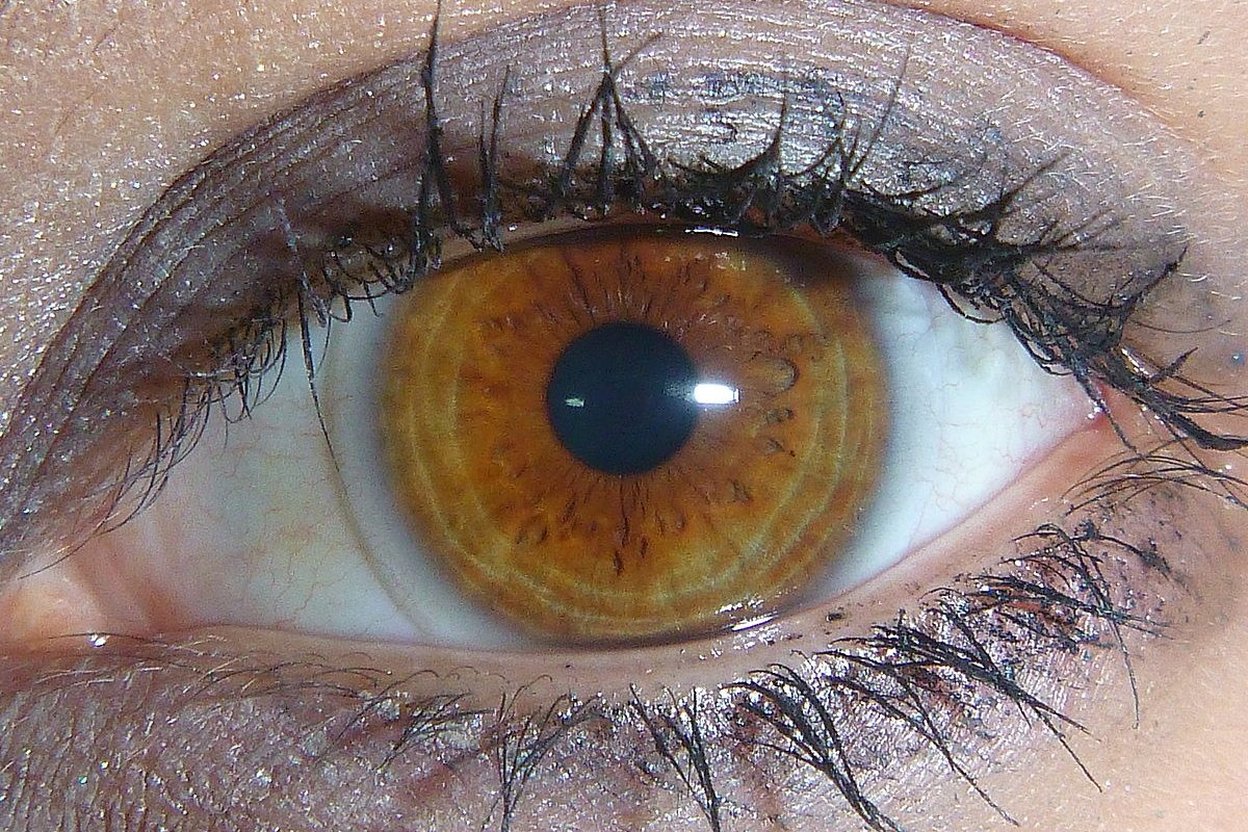
Amber eyes are a solid, even gold-to-copper color across the whole iris. Researchers think the color comes from extra pheomelanin, a yellow-red pigment, mixed with the usual brown pigment. The figure you'll see most often is that about 5% of people have them. People call them "wolf eyes" because adult gray wolves usually have yellow, gold or amber eyes. The main difference from hazel is that amber is one even shade, while hazel is a mix of brown and green that changes from the center of the iris to the edge.
The details below show where the science is solid and where it's still a best guess.
What amber eyes look like
Picture the color of honey held up to a window, or a copper penny. That's the amber range. It runs from pale yellow-gold to a deep reddish copper.
The giveaway is that the color stays the same across the iris. Look closely at an amber eye in daylight and you won't see a green outer ring or a dark brown band around the pupil. You might see faint flecks, but the overall color stays the same from the pupil out to the edge.
In strong sunlight amber eyes can look like they're glowing. In dim indoor light they often look light brown, which is why plenty of people with amber eyes have "brown" on their driver's license.
Amber vs. hazel: how to tell them apart
These two get mixed up all the time, and eye-color sites don't always agree on where one ends and the other begins. Cleveland Clinic describes hazel as various combinations of green, gold or brown, with less melanin than brown eyes but more than blue or green eyes.
Here's a quick way to check in a mirror by a window:
- Amber: one main color (gold, honey or copper), the same from the pupil to the edge, with little or no green.
- Hazel: two or more colors, usually brown or gold near the pupil fading to green toward the edge. It often looks greener on some days and browner on others, depending on light and what you're wearing.
- Light brown: a flatter, darker tan with no real gold or yellow glow, even in sunlight.
If you see any clear green, you're probably hazel. If it's all gold, you're in amber territory.
The pigment behind the gold
Your iris color comes mostly from melanin in the front layer of the iris, called the stroma. There are two main kinds:
- Eumelanin: dark brown to black. Lots of it gives you brown eyes.
- Pheomelanin: yellow to red. It's the same pigment family that gives red hair its color.
A 1998 study in Experimental Eye Research chemically tested irises of different colors and reported the first direct evidence of both eumelanin and pheomelanin in human irises. The back layer of the iris held almost only eumelanin. The stroma held both. The authors concluded that eye-color differences come from the type of melanin as well as the amount.
The usual explanation for amber eyes is a brown-eye mix with a higher share of pheomelanin, which gives the yellow-gold tint. Be aware that this is a reasonable inference, not a settled finding. A geneticist answering this exact question for The Tech Interactive's Ask a Geneticist said amber is probably brown plus extra pheomelanin, but that he couldn't find research showing it for sure.
What about "lipochrome"?
Many articles say amber eyes come from a pigment called lipochrome. You'll mostly see that word on eyewear and contact-lens shop blogs, which use it as another name for pheomelanin. The iris research cited above measures eumelanin and pheomelanin. It doesn't use "lipochrome." If you read that amber eyes have "a special pigment no other eye has," take it with a grain of salt. The same two melanins show up in irises of every color. The mix is what differs.
How rare are amber eyes?
The common estimate is that about 5% of people have amber eyes, roughly the same as hazel. That's the number The Tech's geneticist gives too.
Treat it as a rough figure. There's no large worldwide survey that sorts people into an "amber" category, partly because nobody agrees exactly where light brown ends and amber begins. For comparison, Cleveland Clinic puts green at about 2% of people worldwide and calls it the rarest of the main eye colors. Brown is by far the most common.
So amber is uncommon, but it isn't the rarest color. Green, gray and true two-color eyes (heterochromia) are all harder to find.
Why are they called wolf eyes?
Because that's what wolves have. Wolf Park, the Indiana wolf research and education center, says wolf eyes come in shades of yellow, brown, gold, orange and even green. Gold and yellow are the classic look.
Wolf pups are born with blue eyes, and Wolf Park says they change to the adult color by about 8 weeks of age. Adult wolves don't keep blue eyes. Some have light gray eyes that can look a little blue in certain light. If you see a "wolf" with bright blue eyes, it's most likely a husky or a wolfdog.
That yellow-gold stare is the look filmmakers and costume makers copy for werewolves, so "wolf eyes" stuck as a nickname for amber eyes in people.
Is eye color controlled by one gene?
No. You may have learned in school that brown beats blue with a single gene. Real eye color doesn't work that way. The Tech's geneticist notes that at least 15 genes play a part, with OCA2 being the most predictive for eye color in general. A later genome-wide study of almost 195,000 people, published in *Science Advances*, found 50 more genetic regions linked to eye color.
No one has found an "amber gene." That fits with amber being a point on a smooth range of colors rather than a separate category with its own cause. It's also why two brown-eyed parents can have an amber-eyed kid.
Can your eyes turn amber later?
Babies' eye color often keeps changing for the first year or so as melanin builds up. After that, in adults, the color should stay put. What changes is how it looks: lighting, clothing color and pupil size can make amber look brown one day and gold the next.
A real change in an adult, especially in one eye, is worth a trip to an eye doctor. Our post on whether eye color can change as an adult covers what causes it.
Thinking about wolf-eye contacts for Halloween?
Gold "wolf" and "werewolf" lenses are a popular costume item every October. The FDA says decorative contact lenses are medical devices and need a prescription, even with no vision correction. Selling them without one is illegal, whether at a costume shop, a beauty supply store or a website that doesn't ask for a prescription.
The risks the FDA lists include scratches on the surface of the eye, infections, reduced vision and even blindness. If you want the look, get a fitting from an eye doctor and buy from a seller that checks your prescription.
Check your own eyes in 30 seconds
- Stand facing a window in daylight. Don't use bathroom lighting.
- Hold a phone camera close and take a sharp photo of one eye, with no flash.
- Zoom in. If the whole iris is one gold, honey or copper color, call it amber. If you see green toward the edge, it's hazel. If it's a flat tan with no glow, it's light brown.
- Compare it with a photo taken indoors. A big swing between gold and brown is normal for amber.
For more on how eye colors come about, see gray eyes vs. blue eyes and our page on green eyes.
Sources (6)
- Cleveland Clinic: Eye Colors
- The Tech Interactive, Ask a Geneticist: Amber eye color
- Prota et al., Characterization of melanins in human irides, Experimental Eye Research (1998)
- Genome-wide association study in almost 195,000 individuals, Science Advances
- Wolf Park interns: wolf eye colors
- FDA: Decorative Contact Lenses for Halloween and More