Night Owls, Morning People, and the November Clock Change
Why night owls and morning people feel the November clock change differently—with the genetics and expert tips to adjust.
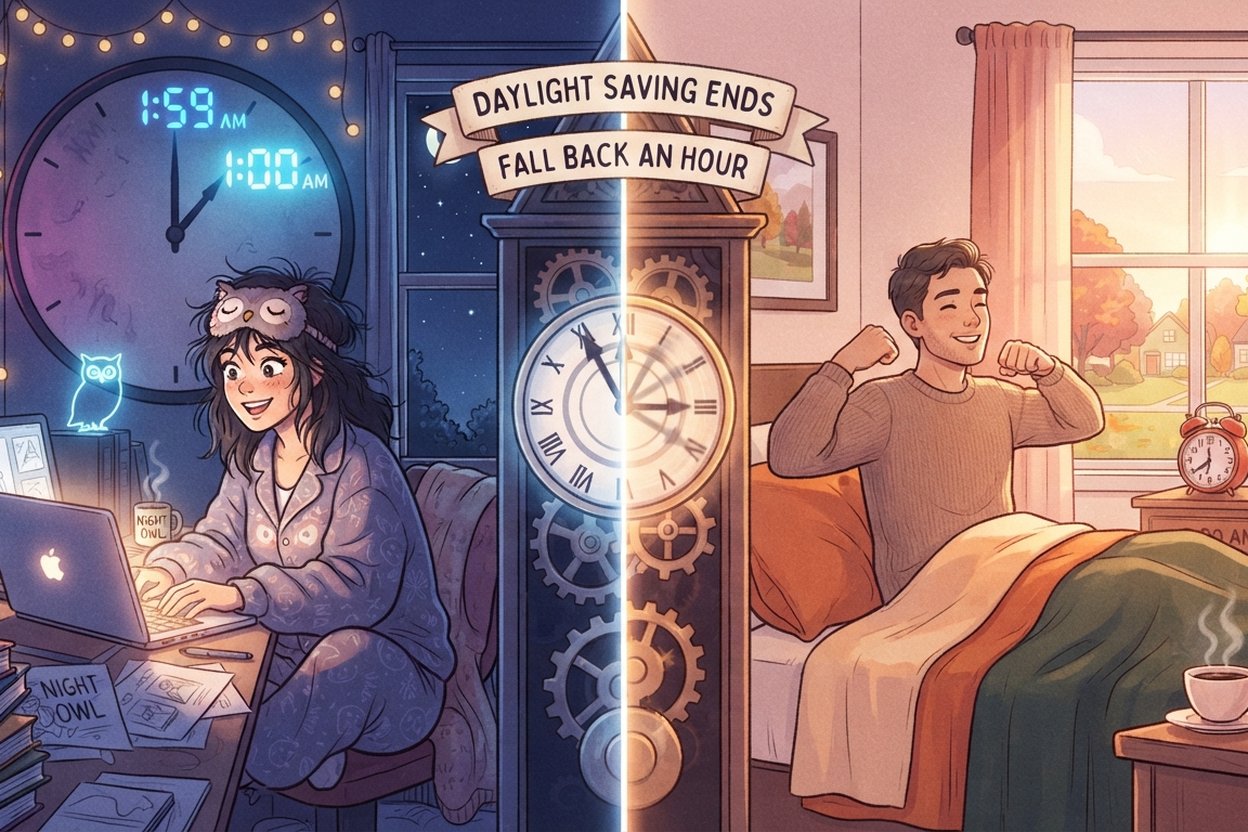
Your phone switches the time by itself, but your body doesn't. If you've ever been wide awake at 5 a.m. the week after "fall back," or found yourself oddly alert at bedtime, that's the November clock change at work. In 2026, daylight saving time ends on Sunday, November 1, at 2:00 a.m. local time, when clocks go back to 1:00 a.m. That's the night after Halloween, so trick-or-treat night comes with a bonus hour. How that hour feels depends on whether you're a night owl or a morning person.
When the clocks change and who it hits
At 2:00 a.m. on November 1, clocks in most of the United States go back to 1:00 a.m. Every state observes daylight saving time except Arizona and Hawaii. Puerto Rico, Guam, American Samoa, the Northern Mariana Islands and the U.S. Virgin Islands don't change their clocks either. Arizona has reportedly stayed on Mountain Standard Time all year since 1968. The Navajo Nation, which reaches into the state, does observe daylight saving time.
For everyone else, the hour shifts against your body clock. On Monday, a 7:00 a.m. alarm goes off at what your body still thinks is 8:00 a.m. For someone who struggles to get up, that helps for a while. An early riser has the opposite problem: their eyes open at 5 a.m. on the new clock, and by evening they're fading earlier than the clock says they should.
No study has measured whether owls or larks handle the fall change better. The "owls have it easier" idea comes from the arithmetic above, not from data. What's well established is that both types need a few days to catch up. To see why the change lands differently, it helps to know what those two labels actually mean.
What "night owl" and "morning person" mean
Scientists call your natural timing your chronotype: when your internal clock wants you to sleep, wake, and be at your sharpest. "Lark" and "owl" are shorthand for the two ends. Most people fall somewhere in between.
Chronotype is a spectrum, not two boxes. Researchers often measure it on a scale from "definite morning" to "definite evening," with plenty of people in the middle categories. Where you land comes from a mix of things. Northwestern University sleep researcher Kristen Knutson has described chronotype as roughly half genetic. The rest comes from environment (light exposure, work hours, habits) and age. Being an evening type is associated with being younger, which is why teenagers and twenty-somethings are known for staying up late and why many people drift earlier as they get older.
So part of being an owl is habit and part is circumstance. The genetic part, though, turns out to be surprisingly specific.
The genetics
Twin and family studies estimate that chronotype is 12% to 42% heritable. The range is wide because different studies measure it in different ways, but they agree that genes play a real role.
The biggest look so far came in January 2019, when a study in Nature Communications analyzed 697,828 people from the UK Biobank and the consumer genetics company 23andMe. It raised the number of genetic regions known to be linked to being a morning person from 24 to 351.
The study didn't rely only on what people said about themselves. About 85,760 participants wore activity monitors, which showed that the effect is real but small. The 5% of people with the most morning-linked variants went to sleep about 25 minutes earlier than the 5% with the fewest. They didn't sleep longer or better, just earlier.
Many of these regions sit near genes involved in the body's internal clock. Three earlier genome studies from 2016, with sample sizes of 89,283, 100,420 and 128,266 people, all flagged PER2, a well-known "clock gene" that helps set the body's roughly 24-hour rhythm.
The 2019 study also tested what chronotype might affect. It found evidence that being a morning person is causally linked to better mental health. It found no such link to body mass index or type 2 diabetes risk. That brings up the bigger question of what happens when a body clock doesn't match the world's schedule.
Why owls and larks feel the shift differently
School bells, office hours and morning meetings are mostly set for early risers. For a night owl, the gap between body clock and schedule never fully closes. Researchers call this social jetlag: living every week as if you'd flown a time zone or two east on Monday and back on Saturday. Owls are hit harder, and social jetlag has been linked to diabetes, inflammation and metabolic syndrome.
The best-known warning came from a 2018 study in Chronobiology International, which followed participants for an average of 6.5 years. Definite night owls had a 10% higher risk of death than definite morning larks.
That number needs context. The study showed an association, not proof that staying up late shortens your life, and the researchers said they didn't fully understand the result. Their possible explanations included:
- a mismatch between the body's clock and daily obligations
- social isolation
- more chances at night for things like substance use
A clock change is a short version of that mismatch, pushed on everyone at once. Commonly cited estimates say most people adjust to the fall change in about three to five days. That estimate is supported by research finding that people woke earlier for about four mornings after the change. Larks are likely to notice those early wake-ups most. Owls get a brief break before their usual schedule catches up with them.
Tips for the week of November 1
The adjustment can't be skipped, but it can be made easier. Sleep experts commonly suggest a couple of simple steps. This is general information, not medical advice.
- Ease in ahead of time. In the days before November 1, shift bedtime and wake time by 10 to 15 minutes. For the fall change, that usually means going a little later, so the hour gets absorbed in small pieces.
- Get light early. Morning sunlight is the strongest signal for setting your internal clock. A walk or coffee outside soon after waking helps your body accept the new schedule.
- Plan around Halloween. The change falls overnight from Saturday, October 31, into Sunday. If the night runs late, the extra hour helps, but a steady wake time on Sunday matters more than sleeping in.
People who wish they didn't have to do this twice a year may get their wish, though nobody knows yet which way the change would go.
Will we keep changing the clocks?
On July 14, 2026, the U.S. House passed the Sunshine Protection Act (H.R. 139) by 308–117. The bill would make daylight saving time permanent. President Trump has publicly backed it.
The Senate is less certain. Senator Tom Cotton has objected that permanent daylight time would push winter sunrises as late as 9 a.m. in some areas. Majority Leader John Thune said, "I just don't think we want a mandate." For now, clocks are expected to fall back on November 1 as usual.
Sleep doctors want permanent time too, just not this version. The American Academy of Sleep Medicine opposes permanent daylight saving time and favors permanent standard time, which better matches morning light. It supports a different bill, the Sunshine for Our Kids Act (H.R. 9638). Meanwhile, 19 states, including Texas, have passed laws to adopt year-round daylight time if Congress ever allows it.
Until Congress settles it, the clock change will keep coming, and night owls and morning people will keep feeling it differently.
Sources (15)
- Time Out: When do the clocks go back in 2026?
- ABC7 New York: Daylight saving time 2026 ending
- Phoenix New Times: Does Arizona follow daylight saving time?
- Neuroscience News: Night owls have higher risk of dying sooner
- Government Executive: Night owls may have 10 percent higher risk of early death
- PMC: Genome-wide association study of chronotype (PMC4786869)
- University of Bristol: Genome-wide association analyses of chronotype in 697,828 individuals
- University of Adelaide digital library: same study
- PMC: Review of chronotype genetics (PMC6084759)
- NBC News: Night owls die young in a world scheduled for early birds
- Tom's Guide: Daylight saving time ends — how it impacts your sleep
- SleepEducation.org (AASM): Keep your sleep in check with the time change
- WebMD: Sleep scientists' tips for a healthier time change
- American Academy of Sleep Medicine: AASM opposes Sunshine Protection Act
- KRIS 6 News: House passes Sunshine Protection Act