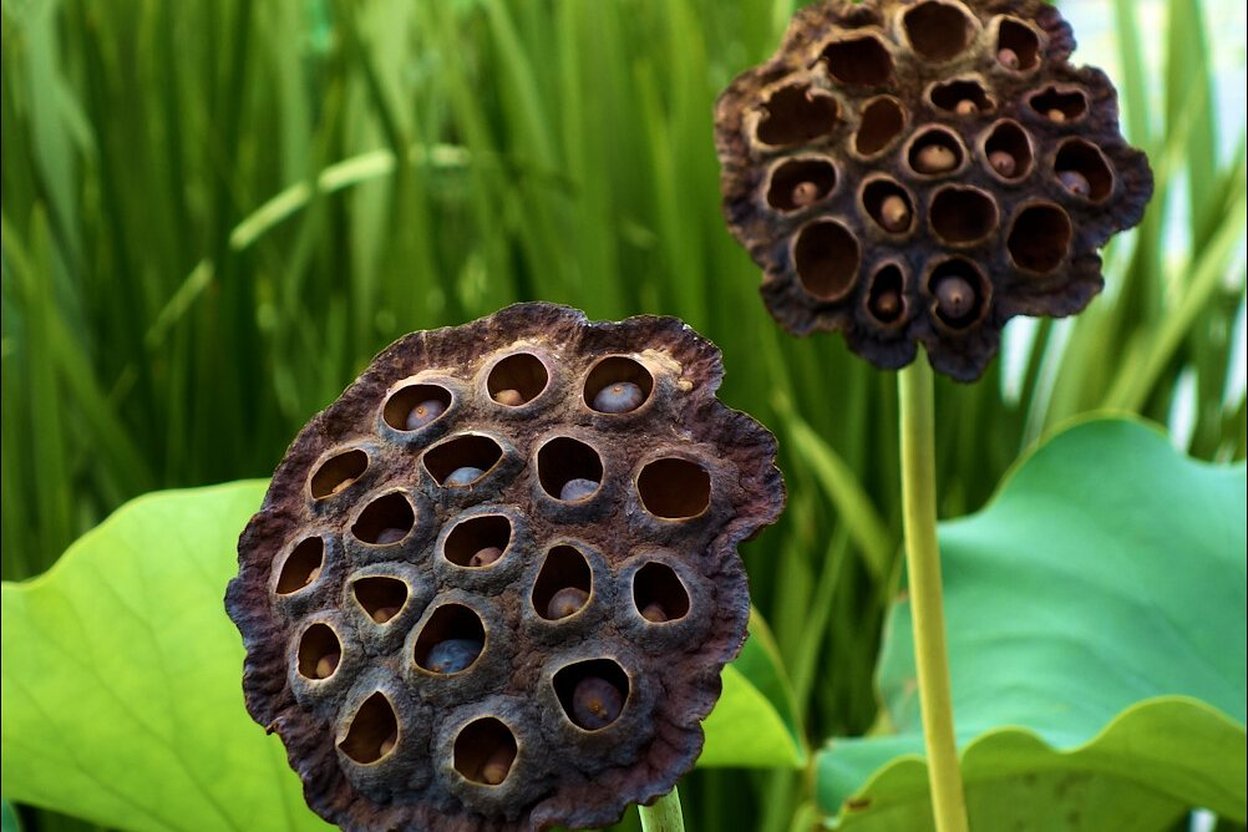
Trypophobia: Why Clusters of Holes Bother Some People
Learn why clusters of holes trigger a disgust response in many people, the science behind the aversion, and how common it really is.
You're scrolling, and a photo of a lotus seed pod fills the screen: a flat green face packed with dark, uneven holes. Your skin prickles, your stomach turns, and you scroll past fast. This reaction is called trypophobia, and a lot of people have it. It isn't a fear of all holes. It's a reaction to clusters of small holes or bumps, and for most people it feels more like disgust than terror. The leading explanation is that the pattern looks a little like diseased skin, and that alarm also goes off for harmless objects.
Why a cluster of holes can feel unbearable
Researchers describe trypophobia as an aversion to clusters of small holes or bumps. Common examples are a lotus seed pod, a honeycomb or the bubbles in aerated chocolate. A single hole doesn't cause it. The first study found that the lotus seed head was the image sufferers named most often. Soap bubbles and aerated chocolate also came up.
The name sounds like fear, but fear usually isn't the main feeling. A survey of 195 members of an online support group asked which emotion dominated:
- 60.5 percent said mostly disgust
- 11.8 percent said only disgust
- 21 percent said equal amounts of disgust and fear
- 5.1 percent said mostly fear
- 1 percent said only fear
Halloween leans on fear, but this reaction is mostly an "ugh," not a scream. The first research paper called it an aversion and partly tied it to visual stress, since people describe disgust, anxiety or plain discomfort.
There are three main explanations for why the pattern causes this reaction:
- Disease: clustered holes and bumps look like skin infections or parasites, and a disease-avoidance reflex fires on harmless things too.
- Poisonous animals: some venomous creatures share the same visual pattern.
- Visual discomfort: the images have a harsh contrast pattern that is hard on the eyes.
So far the evidence favors disease avoidance plus visual discomfort.
What the reaction feels like, and which patterns set it off
The symptoms people report fall into three groups. Some are thoughts and feelings, such as disgust or dread. Some are skin sensations, such as crawling or goosebumps. Others are whole-body reactions, such as nausea or trouble breathing. In the support-group survey, 67.2 percent reported itchiness, 67.2 percent reported goosebumps and 53.8 percent reported nausea. Researchers built the Trypophobia Questionnaire from reports like these. It has 17 items, and people rate how lotus-pod images make them feel on a scale of 1 to 5. Totals run from 17 to 85, and research studies usually count a score above 31 as trypophobic.
The shape of the cluster matters. Clusters of bumps bothered people about as much as clusters of holes, so the trigger is the clustering, not the holes themselves. Among high scorers, a bigger cluster was more uncomfortable. Everyday triggers include honeycombs, sponges, bubbles, seed pods and the holes in bread or cheese. Which of these bothers a given person varies a lot.
What the pattern sits on matters most. In one set of studies, both people with trypophobia and comparison groups disliked clusters linked to disease. Only the trypophobia group also disliked harmless clusters, such as holes drilled into a surface that wasn't part of a body. Pasting hole clusters onto pictures of human skin makes images worse than the same pattern placed anywhere else. This is why edited "holes in skin" pictures online hit harder than a kitchen sponge. Personal history may also play a part. In two online surveys, one with 856 people and a replication with 690, people with a history of skin problems rated these images as more uncomfortable.
How common it is, and why it seemed to show up with the internet
If you flinch at these images, plenty of people share the reaction. How common it looks depends on what's being measured.
In 2013, Geoff Cole and Arnold Wilkins at the University of Essex showed 286 adults one lotus-pod image. They asked whether it was uncomfortable or even repulsive, and 46 people (about 16 percent) said yes. Finding one photo unpleasant is a lower bar than scoring over the questionnaire cutoff. In a later UK survey of 2,558 adults, done in 2016–2017, 9.7 percent scored above 31, and the average score was 21.4. In that sample, 57 percent felt no anxiety at all looking at the lotus images.
Young people score higher. A household survey of 2,065 people aged 15 to 24 in Hong Kong, carried out from 2020 to 2022, found a rate of 17.6 percent using the same cutoff. Cole puts the range from the two large surveys at roughly 10 to 18 percent. He notes that phobias in general are more common in younger people. In the UK survey, average scores fell steadily with age, from 28.2 among 18-to-24-year-olds to 18.3 among people 65 and older.
The evidence on sex differences is mixed. In the UK survey, men and women were about equally likely to cross the cutoff. In the Hong Kong sample, 68.1 percent of those over the cutoff were female.
The word itself is new. It was already in use online around 2005, about eight years before the first peer-reviewed paper, Cole and Wilkins' "Fear of Holes" in Psychological Science. Internet users coined it, not clinicians. It comes from the Greek trypa, meaning "hole," plus "phobia."
What the studies actually tested
Cole and Wilkins started with the images themselves. They compared 76 pictures from a trypophobia website with 76 pictures of holes that don't trigger the reaction. The triggering images had high contrast at midrange spatial frequencies, which roughly means strong light-dark changes at a medium scale. The same property appears in some stripe patterns that people find uncomfortable to look at. It also showed up in images of venomous animals, including the blue-ringed octopus, the deathstalker scorpion and the king cobra. Cole suggested that people may be primed to notice a visual feature shared with dangerous animals. When researchers filtered that extra contrast out of the images, they became less unpleasant.
Later work leaned toward disgust. A 2018 Emory University study measured pupils instead of asking people how they felt. Images of holes made pupils constrict more than images of threatening animals or neutral images did, even in students who didn't report trypophobia. That pattern fits disgust better than fear. Another experiment tested the two evolutionary ideas directly. Putting the patterns on hands, feet and chests changed comfort ratings more than putting them on snakes or spiders. In 126 Japanese adults, higher questionnaire scores went with three things: sensitivity to disease-related disgust, a self-focused, distress-prone kind of empathy, and everyday visual discomfort. The link with general anxiety was weak. A study of preschoolers also argued against a hidden "poisonous animal" alarm. The children found the patterns uncomfortable because of how they looked, and when researchers removed those visual features from photos of venomous animals, the link disappeared.
Is it all internet contagion? Younger people and women, who use social media more, scored somewhat higher, which fits some social learning. But in one UK student sample, 24 percent of people who scored as trypophobic had never heard of the condition. A 1998 case also described a child terrified of holes and repeating patterns, years before the name spread online. The best current answer is an overgeneralized disease-avoidance response plus visual strain, possibly amplified online. That answer isn't settled.
When a flinch is a phobia, and what is known about help
Disliking these images is common. Having a phobia is a different matter. The DSM-5 doesn't list trypophobia as its own diagnosis, and it doesn't keep a list of approved phobias. It sets criteria for specific phobia. Merck's consumer guide (reviewed April 2026) summarizes them: intense fear or anxiety about a specific thing that starts right away, is out of proportion to the danger, leads to avoidance, lasts six months or more, causes significant distress or trouble functioning, and isn't better explained by another disorder.
Many people who hate these images don't meet that bar, even in the most affected group studied. In the support-group survey, 29.7 percent met every criterion. Another 51.8 percent met all of them except significant distress or impairment. Symptoms had lasted 18 years on average, and about 15 percent reported significant impairment at work or school. Of the respondents, 89.2 percent had never sought treatment. These figures come from the 1.6 percent of a 12,000-member group who chose to answer, so they don't represent everyone with the reaction. Depression and anxiety were common in that group. In the Hong Kong youth survey, scoring as trypophobic was modestly linked to anxiety, depression and stress.
No treatment for trypophobia has been proven in a trial. For specific phobias in general, Merck calls exposure therapy the treatment of choice. Medicines don't usually remove a phobia. One published case of a 12-year-old girl treated with medication and therapy is just one case, not evidence of a standard treatment. If the reaction is disrupting daily life, a mental health professional is the right person to assess it.
Sources (13)
- ScienceDaily: Fear of holes (2013)
- The Atlantic: Who's afraid of a cluster of holes?
- Cole, "Is trypophobia real?" BJPsych Open
- UK adult survey (PMC11445973)
- Support-group survey (PMC7111417)
- Japanese adult study (PMC5005243)
- University of Essex repository: Trypophobia Questionnaire
- Frontiers in Psychiatry review (2018)
- Hong Kong youth study, BJPsych Open
- Emory News: Aversion to holes driven by disgust
- Psych Central: Trypophobia
- Cleveland Clinic: Trypophobia
- Merck Manual: Specific phobic disorders
Photo: lotus seed pods by kiszka king, BY 2.0.