The Cilantro-Tastes-Like-Soap Gene
Why cilantro tastes like soap to some people: the OR6A2 smell gene, how many people it affects, and why genes explain only part of it.
If cilantro tastes like dish soap to you, your nose may be the reason. In 2012, researchers at the DNA-testing company 23andMe linked the soapy taste to a genetic variant on chromosome 11. It sits in a cluster of smell-receptor genes that includes OR6A2, a receptor that is very good at picking up the aldehydes that give cilantro its smell. One study found that between 3% and 21% of people dislike cilantro, depending on ancestry.
That's the short answer. The longer one is that the gene is real, but it explains much less than most headlines claim.
What the 2012 study found
The main study is Eriksson and colleagues, published in the journal Flavour in 2012. They took 14,604 people of European ancestry who had answered one question: does cilantro taste soapy to you? Then they ran a genome-wide scan, comparing the DNA of the people who said yes with the people who said no.
One spot stood out. A single-letter variant called rs72921001 was tied to the soapy report strongly enough to pass the usual genome-wide threshold (p = 6.4 × 10⁻⁹). The team then checked it against a separate group of 11,851 people who had answered a different question, whether they liked cilantro. The same variant showed up again.
That variant isn't inside OR6A2 itself. It sits near a group of olfactory receptor genes, and OR6A2 is the likeliest candidate in the group because of what it detects.
Why it's a smell gene, not a taste gene
Your tongue only picks up a few things: sweet, salty, sour, bitter, umami. Most of what you call "flavor" is smell, coming up the back of your throat while you chew.
OR6A2 is a smell receptor. It responds to aldehydes, a family of fatty compounds. Cilantro is full of them, including decanal, (E)-2-decenal and (E)-2-dodecenal. Food-science writer Harold McGee pointed out in a 2010 New York Times piece that cilantro's aldehydes are very similar to ones found in soaps and lotions, and to compounds some insects give off. So when someone says cilantro tastes like soap, they're describing the chemistry pretty accurately. Their nose is picking up a compound that really does show up in soap.
Why one nose tunes in to that note and another doesn't is the open question. The working idea is that some versions of the receptor make the soapy aldehydes stand out, while other people mostly notice the fresh, green, citrusy side of the herb.
This is a different system from the bitter-taste genes behind supertasters. Supertasters react to bitter compounds through receptors on the tongue. Cilantro haters are reacting through the nose.
How many people have it
The best-known numbers come from a separate 2012 study by Mauer and El-Sohemy at the University of Toronto. They surveyed 1,639 young adults (ages 20–29) and found cilantro dislike varied a lot by ancestry:
- East Asian: 21%
- European (Caucasian): 17%
- African: 14%
- South Asian: 7%
- Hispanic: 4%
- Middle Eastern: 3%
Two cautions with those numbers. First, they measure dislike, which isn't the same as carrying the gene variant. Plenty of people dislike cilantro for other reasons, and plenty of carriers have learned to eat it. Second, the groups that dislike it least (Hispanic, Middle Eastern, South Asian) come from food cultures where cilantro is everywhere. Growing up on salsa, chutney or Middle Eastern salads probably shapes how you feel about it as an adult.
The Cleveland Clinic also notes that women report the soapy taste slightly more often than men.
How much of it is genetic
Less than you'd think, and this is where most articles oversell it.
- Twin studies: Research on twins, which the Eriksson paper cites, estimated that genes account for roughly 38% of the variation in disliking cilantro's smell and 52% of the variation in disliking its flavor. Those numbers come with wide error ranges and some assumptions, so read them as a rough guide.
- The DNA study itself: Eriksson's team calculated that all the common genetic variants they measured together tagged a heritability of only about 0.087, or under 9%. The one famous variant explains a small slice of that.
So there's real evidence of a genetic link, but no single "cilantro gene" that decides the matter. A consumer DNA test that says you carry the soapy variant is giving you a slightly higher chance of disliking cilantro, nothing more. Lots of people with the variant like the herb fine, and lots without it can't stand it.
That makes the soapy-cilantro trait a lot like the others on this site: partly in your genes, partly in how you were raised. Others in that group include being left-handed and the photic sneeze reflex.
Can you learn to like it?
Some people do. Two things seem to help.
Crush it. McGee's tip from 2010 was to try cilantro in a pesto. Crushing the leaves releases enzymes that break down the soapy aldehydes into milder-smelling compounds. The Cleveland Clinic gives the same advice. If you're making salsa verde or chimichurri, a mortar and pestle or a food processor will give you a milder result than chopping.
Keep eating it. Repeated, pleasant exposure can change how the brain reads a smell over time. The low dislike rates in cultures that cook with cilantro every day fit with that, even though that survey can't prove cause and effect.
If you'd rather skip it, the Cleveland Clinic suggests flat-leaf parsley, dill, oregano, Thai basil, Vietnamese coriander, papalo or pipicha. Parsley is the easy swap for color and freshness in a taco or a bowl of chili on a cold fall night. Thai basil or Vietnamese coriander works better in Southeast Asian dishes.
One naming note: in the U.S. and Canada, "cilantro" means the leaves and "coriander" means the dried seeds. In the UK and most other countries, the whole plant is called coriander. The seeds don't have the same aldehyde punch, so plenty of cilantro haters are fine with ground coriander in a spice rub.
Quick facts to remember
- The variant tied to soapy cilantro is rs72921001 on chromosome 11, near the smell-receptor gene OR6A2.
- The soapy note comes from aldehydes, compounds closely related to ones used in soap.
- Dislike ranges from about 3% to 21% depending on ancestry, in one Toronto study of 1,639 young adults.
- Genes are only part of it. Common variants explained under 9% of the variation in the 23andMe data.
- Crushing the leaves into a pesto or sauce can soften the soapy taste.
Sources (5)
- Eriksson et al., "A genetic variant near olfactory receptor genes influences cilantro preference" (arXiv / Flavour, 2012)
- Mauer & El-Sohemy, "Prevalence of cilantro disliking among different ethnocultural groups" (Flavour, 2012)
- OR6A2 (Wikipedia)
- Cleveland Clinic: Can a Gene Cause Cilantro To Taste Like Soap?
- NPR: Love To Hate Cilantro? It's In Your Genes And Maybe, In Your Head (2012)
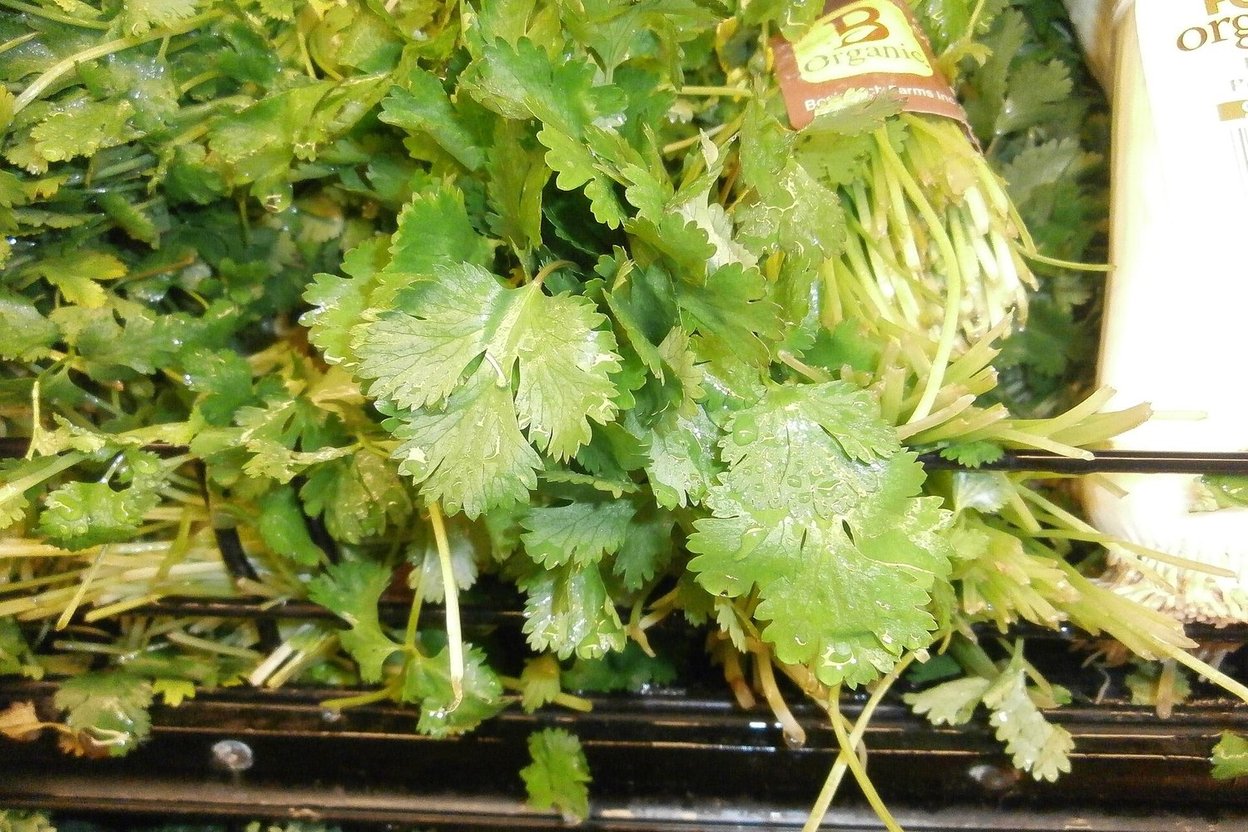
Photo: Cilantro bunches in a stack by Jeffery Martin, CC0.