Why Does Christmas Make People Feel Nostalgic?
Christmas triggers nostalgia through familiar smells, songs, and people we miss. Here's what the research says about why the past feels so warm.
The first carol plays in a store, a cinnamon smell drifts out of a kitchen, and suddenly you're eight years old again and also a little sad about it. Christmas does this to a lot of people, and the reasons are fairly well understood. The season packs strong memory cues into a few weeks. It centers on the people in your life, including the ones who aren't there anymore. Researchers also suggest that remembering feels good in its own right, and that nostalgia pulls people toward each other.
The short answer
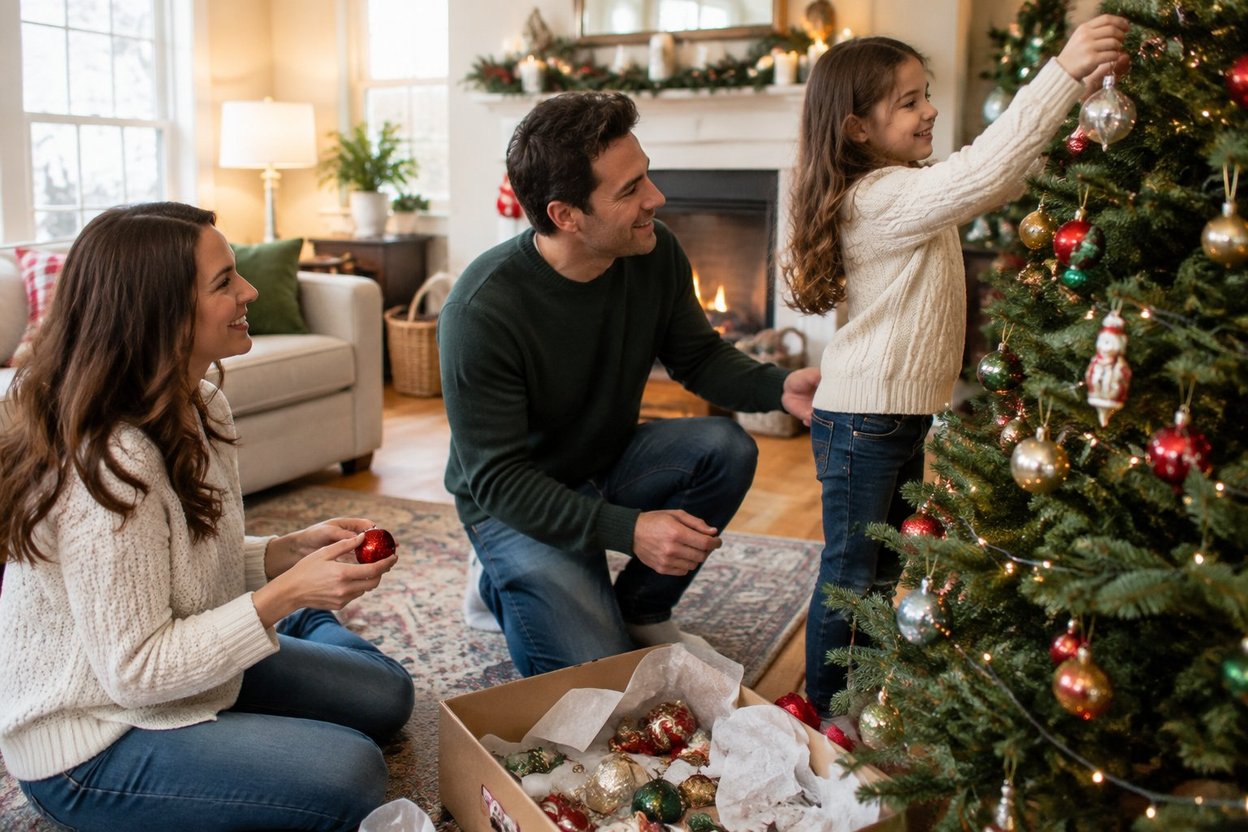
Most seasons have a few memory triggers. Christmas has dozens, and they come back every year in nearly the same form. The same songs play, the same foods get cooked, the same ornaments come out of the same boxes, and families repeat the same rituals. Researchers at Warwick Business School named festive food smells, holiday music and decorations as cues that can set off nostalgia.
The holiday also revolves around relationships. Krystine Batcho, a psychologist at Le Moyne College who studies nostalgia, notes that holidays bring people together, including "when they cannot be together." Missing someone is one of the strongest pulls toward the past, and Christmas puts that feeling front and center.
Two more pieces explain why the feeling can be pleasant instead of just painful. Research on memory suggests that the act of remembering produces a warm feeling of its own, which can make the past seem better than it was. Psychologists have also linked nostalgia to feeling connected and to a sense of meaning in life. Cues trigger the memories, the people give them weight, and the remembering itself feels good. To see why that mix works, it helps to start with what nostalgia is, because the word began as something very different.
What nostalgia actually is
Nostalgia started out as a medical diagnosis. In 1688, a Swiss medical student named Johannes Hofer wrote a dissertation about a condition affecting Swiss soldiers and mercenaries serving far from home. They suffered fatigue, anxiety, heart palpitations and fevers, and the symptoms often eased once they went home. Hofer named the condition from two Greek words: nostos, "homecoming," and algos, "grief" or pain. So the original meaning was close to what we'd now call severe homesickness.
Over time the longing shifted from a place to a time. By 1833, a medical journal was describing people who longed for "the scenes of their youth." By the early 1900s artists were using the word, and by 1915 it showed up in poetry with its everyday meaning of wistful longing for the past.
Today psychologists treat it as a normal emotion, not an illness. Batcho says the most common modern definition is "a bittersweet sentiment." She separates personal nostalgia, for the past you lived through, from historical nostalgia, for times "when the individual might not even have been alive yet." She describes nostalgia as universal across cultures and ages. Researchers now see it as mostly positive and strongly social, though it keeps a trace of the ache in its Greek name. Christmas brings out that ache on schedule, beginning with the senses.
Smells, songs and sights as memory triggers
Christmas cues are unusually concentrated. Gingerbread, pine, roasting meat and orange peel are smells that many households only produce in December. Holiday songs get played for a few weeks a year, often the same recordings decade after decade. Lights, ornaments and wrapping paper mark the season too. Because these cues come back almost unchanged each year, each one ties into memories from many past Christmases at once. The same thing happens as stores start selling the season early: a display going up soon after Halloween can bring back a whole childhood of Decembers.
Smell gets the most attention. A 2011 study in Neuro Endocrinology Letters by Matsunaga and colleagues found that smelling an odor linked to a nostalgic memory raised people's reported comfort and happiness and lowered their anxiety. It also lowered their heart rate and levels of interleukin-2, an immune signaling molecule. The authors suggest that memories triggered by smell tend to be more emotional, probably because smell connects directly to the amygdala, a brain region involved in emotion.
That idea is popular, but it isn't settled. The Matsunaga study was a single small study. A 2018 study in the journal Memory reportedly found that childhood-related smells brought back richer memories than images did, but an analysis of how people described those memories found no difference in their emotional content. The fairest summary is that smell-triggered memories are often reported as more emotional, while the evidence on whether smell is truly special remains mixed.
A trigger only explains why a memory shows up, though. It doesn't explain why the memory feels so warm.
Remembering feels good, even when the past wasn't
Dr. Tamara Ansons of Warwick Business School and Jason Leboe-McGowan of the University of Manitoba proposed an explanation for the warm part. In their view, the glow comes from the experience of successfully recalling something, not from the past actually being better. "The results show that it is the act of remembering that gives us pleasure not the actual memory," Ansons said.
Their first paper reported six experiments. Participants studied words, and some words were repeated and imagined. Those words were remembered better, which is expected. They were also more often misremembered as having been paired with a positive word, even when they had been paired with a negative one. "It seems the act of remembering made the subjects think the word had a positive word next to it," Ansons said. The ease of remembering spilled over into how good the memory seemed.
A second paper, with two more experiments, found the same rosy bias toward the past in general. When people saw news stories from different eras, they tended to place the non-violent stories in a more distant decade. That suggests the bias can extend even to years a person never lived through.
Applied to Christmas, the idea is that a familiar carol is easy to recall, recalling it feels good, and that good feeling gets credited to the Christmases of the past. This rosy filter is part of the story. The other part is about who those memories include.
Loneliness, missing people and connection
Christmas is built around being with others. That makes absences harder to ignore: a parent who has died, a grandparent's recipe nobody makes quite right, siblings now spread across the country. Batcho points out that loneliness is a known trigger for nostalgia, and that nostalgia in turn helps people feel less alone. A 2008 review by researchers at the University of Southampton also lists negative mood and loneliness among nostalgia's triggers.
Batcho calls nostalgia "almost like a psychological substitute for the real thing." When people can't be together, remembering past gatherings brings back some of that togetherness. She says this applies to people who have lost loved ones, which is one reason the holidays can feel tender and comforting at the same moment.
Nostalgia isn't only for people who are missing someone. Batcho says that even at happy gatherings, older relatives telling stories to younger ones can strengthen a family's sense of who it is, something "that helps unite the family around a sense of connectedness." Thanksgiving tables later this fall will see a lot of that.
The research points the same way. A 2011 study in the Journal of Personality and Social Psychology by the Southampton team reportedly found that nostalgia increased people's sense of meaning in life, and that feeling socially connected accounted for the effect. So the people you miss at Christmas are part of what triggers nostalgia, and also part of what makes it feel good.
Is it good for you?
Mostly, according to the people who study it. In a 2018 review in Review of General Psychology, Southampton psychologists Constantine Sedikides and Tim Wildschut describe nostalgia as a source of meaning, mainly because it raises social connectedness and secondarily because it gives people a sense that their life is continuous over time. The review also covers its links to vitality and to coping with stress and boredom. Wildschut has said that nostalgia "elevates meaningfulness, connectedness and continuity" and helps restore emotional balance.
There are caveats. Nostalgia is bittersweet by definition, and the sweetness doesn't erase the loss behind it. A 2019 review in the European Review of Social Psychology reportedly found downsides at the group level, including rejecting people seen as outsiders. Nostalgia is also good for sales: Ansons links the pull of vintage clothing, antique furniture and 1970s hits to the pleasure of nostalgia, even for things people didn't like at the time. When a holiday ad brings a lump to your throat, that reaction is the goal.
Sources (11)
- Warwick Business School: Christmas nostalgia produced by the act of remembering (press release, revised December 2014)
- NBC News / LiveScience: interview with Krystine Batcho on holiday nostalgia (2011)
- Useless Etymology: The tragic etymology of "nostalgia"
- NPR: history of the word "nostalgia"
- Matsunaga et al., 2011, Neuro Endocrinology Letters: Psychological and physiological responses to odor-evoked autobiographic memory
- 2018 study in Memory on odor- and image-evoked childhood memories (PubMed)
- University of Southampton, 2008 review on nostalgia
- University of Southampton, 2011 Journal of Personality and Social Psychology study on nostalgia and meaning
- Sedikides & Wildschut, 2018, Review of General Psychology
- Tedium: The psychology of Christmas nostalgia (2024)
- University of Southampton, 2019 European Review of Social Psychology review