Why Do Christmas Crackers Have Jokes Inside?
Learn how a 1840s London sweet maker's love mottoes turned into the groan-worthy jokes inside Christmas crackers today.
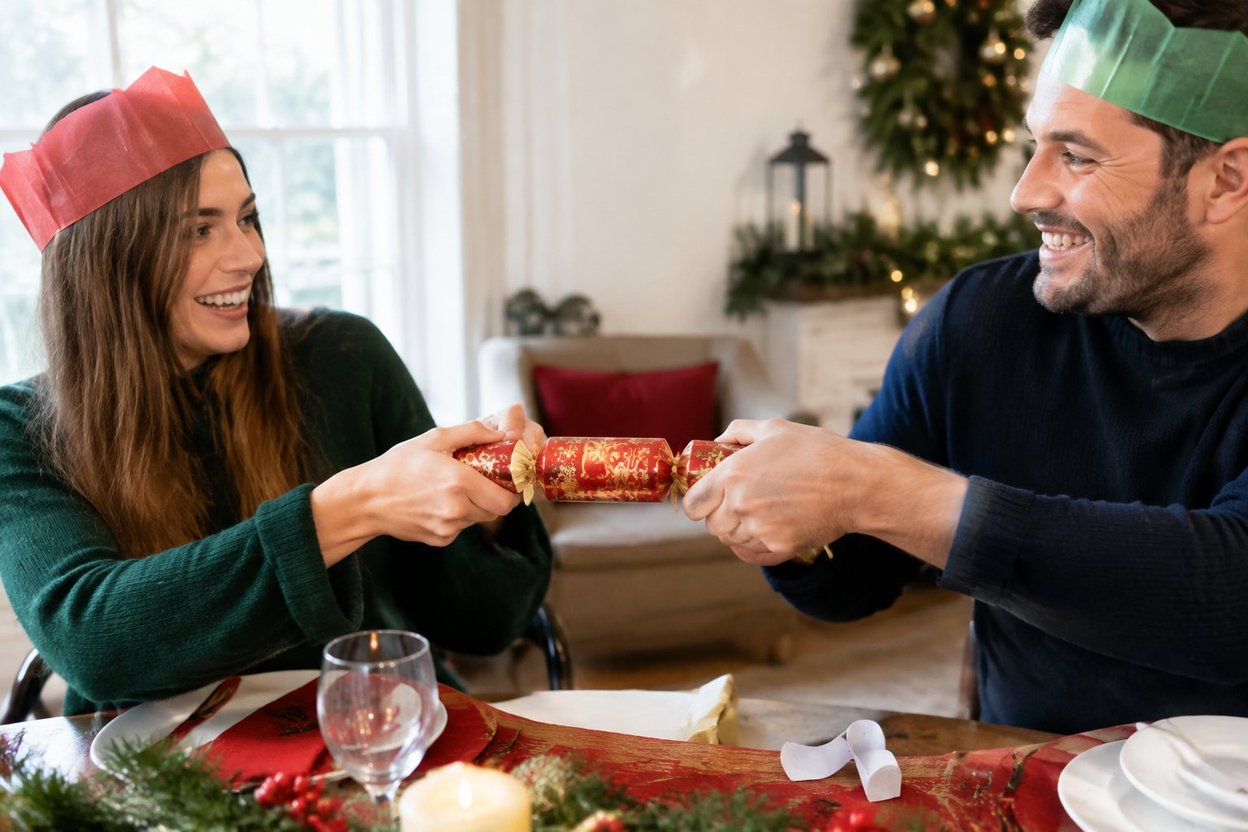
You've seen it in a British Christmas movie, or maybe at a holiday table set the British way: two people pull a shiny paper tube, it goes off with a snap, and someone unfolds a slip of paper and reads out a terrible pun. The joke is there because of a London sweet maker who, in the 1840s, tucked a short love message inside a wrapped sweet to help it sell. The cracker kept growing, adding a bang, a paper hat and a small gift. Along the way the romantic message turned into a joke, and the worse the joke, the better.
The short answer
The Christmas cracker started out as a sweet in a twist of paper. Tom Smith, a London confectioner, is traditionally credited with the idea, and the Oxford English Dictionary records people pulling crackers from 1847. To keep his sweets selling, Smith slipped a small love motto inside the wrapper. Later came the snap, then hats and gifts. Over the decades the love verse gave way to the joke, riddle or bit of trivia that crackers still carry.
Some of this story is legend. The dates don't line up neatly from one source to the next, one charming detail looks a lot like old marketing, and Smith may not even have been first. The outline holds up, though: a small message in a wrapper as a sales gimmick, which later turned into a joke.
Tom Smith and the French bonbon
According to the Victoria and Albert Museum, Smith opened a shop on Goswell Road in Clerkenwell, London, in the 1840s, where he made wedding cakes and sweets. On a trip to Paris he saw the French "bon bon": a sugared almond wrapped in a twist of paper. Sources disagree on when he went. Some say 1840, while a V&A blog post puts the trip in the 1830s.
Smith started selling wrapped sweets in London. The trouble was that they sold well at Christmas and slumped for the rest of the year. To boost sales, he put a small love motto inside each wrapper.
The bang came next. The usual story is that Smith heard a log crackle in his fireplace and decided to put that pop into his sweets. Sources call that tale "supposedly" true, and two suggest it was most likely marketing, adding that the explosive strips may have come from Brock's Fireworks. The V&A says Smith patented his first cracker device in 1847 and perfected the mechanism in the 1860s.
The product didn't start out as a "cracker." It was first sold as the Cosaque, French for Cossack. "Cracker" became the everyday name once competitors started making their own.
Smith's claim to be first is also disputed. The company of a rival maker, Gaudete Sparagnapane, was founded in 1846, a year before Smith's crackers went on sale.
How a motto became a joke
The cracker most people know today is mostly the work of Tom Smith's son, Walter. With rival firms copying the idea, Walter set the family business apart by adding small gifts, paper hats and a wider range of designs. One account dates his changes to the 1870s, after his father's death, and says they included new mottoes and jokes.
The messages kept moving away from romance. The V&A notes that makers of novelty crackers hired writers to supply "snappy lines." The museum's Totem Cracker of 1927 contained "quips and jokes" alongside its other contents. The V&A archive also holds uncut printed sheets of mottoes and jokes from the Tom Smith Group, waiting to be cut into strips and rolled into tubes.
The verses weren't treated as fine writing even before the jokes took over. In 1906 the Westminster Gazette dismissed a weak play as "not up to the standard of cracker poetry," which shows that cracker rhymes were already a byword for bad writing.
Sources don't give an exact year when jokes fully replaced love mottoes. The 1927 Totem cracker is the clearest evidence of jokes in crackers, and by the 20th century the joke had become the standard filling.
What is inside a cracker, and how the bang works
A modern cracker is a cardboard tube wrapped in bright paper. Inside are three standard items: a paper crown, a small toy or gift, and a joke on a strip of paper. Two people each hold one end and pull. The tube tears apart, and whoever ends up with the bigger piece usually keeps what's inside.
The snap comes from a thin strip that runs the length of the tube and is treated with a shock-sensitive chemical. When the cracker is pulled, friction across the strip sets it off. One chemical used is silver fulminate, which pops when it's rubbed but is used in tiny amounts.
The paper crown has a less certain history. Some sources suggest it was inspired by Epiphany cakes, which were topped with paper crowns. Wikipedia says the hat tradition is "believed" to go back to the Roman winter festival of Saturnalia. Neither origin has been proven.
Early cracker makers also experimented with the gifts and themes. Early themed crackers included suffragette designs and Charlie Chaplin designs. Gifts in crackers aimed at "bachelors and spinsters" reportedly included false teeth and wedding rings.
Why the jokes are so bad
The joke isn't supposed to be good. Everyone at the table knows that, and the groan that follows is part of the tradition.
Chris Head, an associate lecturer in comedy at Bath Spa University, has explained how these jokes work. Most use a question-and-answer format, and the humor depends on wordplay. Writers often begin with the punchline and work backward to a setup that fits. He says the groan is the goal: "for cracker writers, groaners are their bread-and-butter – the bigger the groan the more successful the joke." He adds: "Eliciting a response about how terrible the joke is, is part of the fun."
That fits the 1906 jab about "cracker poetry." For more than a century, the words inside a cracker have been known as gloriously weak, and that's now part of their charm. A bad joke is one everyone can enjoy: it doesn't need much setup, nobody gets left out, and the whole table can groan together.
Who writes the jokes in an ordinary store-bought box is another matter. The histories of the cracker say novelty makers hired writers, but they don't name the people behind the standard jokes.
Crackers today
Tom Smith & Company grew fast. By the 1890s it employed about 2,000 people, and in the 1950s and 1960s it was making 30,000 crackers a week, according to the V&A. In 1953 it merged with Caley Crackers. A 2017 Express article, quoted by a London history blog, says Tom Smith crackers have been supplied to the Royal Family since 1910.
The record-setters have taken crackers much further. The longest cracker on record was 63.1 meters (207 feet) long and was made in Chesham, England, on December 20, 2001. The largest cracker pull brought together 1,478 people in Japan on October 18, 2009.
With Thanksgiving coming up and holiday tables on the way, a box of crackers is an easy way to try the tradition. When the joke turns out to be awful, it's working as intended.