Are the Macy's Thanksgiving Parade Singers Really Singing Live?
Learn why most singers at the Macy's Thanksgiving parade lip-sync instead of performing live, and which performances were the real deal.
It's Thanksgiving morning, the coffee is on, and a pop star rides past on a giant float, smiling and singing straight into the camera. Then you notice that the voice sounds exactly like the radio version, even though it's freezing out and the float is moving. You're right to be suspicious. Most singers on the Macy's Thanksgiving Day Parade lip-sync to pre-recorded tracks. A few have sung live, and the reasons for both come down mostly to engineering, not ego.
The short answer
For most acts, the singing isn't live. Performers on moving floats usually mouth the words to studio recordings, cast albums or soundtrack versions of their songs. Wikipedia's account of the parade says this applies to most "live" performances by both Broadway casts and solo artists. It gives one main reason: a wireless microphone is hard to use on a moving vehicle.
There are exceptions, but they're rare. Wikipedia names Tony Bennett in 2016 as an example of a fully live performance with no recorded vocals. Other singers have said they sang live too. Those cases tend to involve the stage at Macy's Herald Square, not a float in the middle of the route.
This year the question gets more attention than usual. The parade began in 1924, and the 2026 edition on Thanksgiving Day, November 26, is counted as the 100th.
Where and how the performances happen
Singers aren't performing for the whole route. In 2025 the parade covered 2½ miles, from West 77th Street and Central Park West down to Macy's Herald Square. There were 28 floats and 28 performers, according to NBC News. For most of that distance, a float carrying a star is a moving display, not a concert.
The televised performances happen in Herald Square, where the broadcast cameras are set up. That's also the reason for the microphone in a singer's hand. Wikipedia says the NBC-flagged mics used by performers on floats are "almost always non-functioning props." A poster on a theater-technician forum who said they had worked the event made the same claim: the mics are props, and the performances happen only in Herald Square. That's an anonymous account, but it matches the rest of the evidence.
The audience at home sees the event as a TV show. NBC airs it live starting at 8:30 a.m. Eastern, and Peacock streams it at the same time. The parade is live, but the soundtrack of each number is often prepared in advance, much like a halftime show.
Why they lip-sync
The clearest explanation came from a performer. In 2018, John Legend said: "We all have to lip sync on this parade because the floats don't have the capacity to handle the sound requirements for a live performance." A live vocal needs microphones, monitors, mixing and amplification, all of which need power and space. Floats are built to look good, and they don't have room for a concert sound system.
Audio professionals point to more problems. AVIXA, a trade group for the audio-visual industry, asked its audio staff why parade performances are lip-synced. Their answer starts with the airwaves. Midtown Manhattan's radio frequencies are heavily congested, and wireless microphones and in-ear monitors compete for limited bandwidth. AVIXA's Coran Smith called Times Square a "frequency death trap" for that equipment. A dropout or burst of interference on national TV is exactly what producers try to avoid.
The AVIXA staff listed other reasons:
- Cold. Late-November mornings in New York can be bitter, and cold air tightens the vocal cords. Singing well at 9 a.m. in the cold is hard, even for professionals.
- Power. Supplying reliable electricity to a moving float is a challenge in itself.
- The schedule. The broadcast runs on a tight clock, and each act gets a short, fixed slot. A pre-recorded track lasts exactly as long as planned every time.
- Age. Some veteran artists can no longer hit the notes they recorded decades ago, and a recording lets them sound the way viewers remember.
Together these explain why the network wants consistent sound. A recorded track removes the main risks at once: the weather, radio interference, the power supply and the clock.
Famous moments and exceptions
The system doesn't always work. In 2018 several performances were visibly off, and Macy's put out a statement, relayed by AOL, saying that "several recording artists experienced technical difficulties that negatively impacted their performance." The company called the problems "out of the artist's control."
Rita Ora's performance that year was widely seen as a lip-sync mistake, because her mouth and the audio didn't match. She responded by pointing out that her own shows "are 100 percent live always have been." That same year, John Legend's explanation about the floats spread widely as people tried to work out what they had just watched.
Kelly Clarkson told a different story about her own performance in 2018. She said on Instagram that she had sung live, and she thanked Brynn Cartelli for singing with her in the cold. Tony Bennett's 2016 appearance is the example Wikipedia cites of a live performance with no recorded vocals at all.
Viewers haven't gotten used to it. In 2024, people online criticized Billy Porter's opening number and the cast of the Broadway musical Hell's Kitchen for lip-syncing. No official response was reported. Every year, some viewers learn about lip-syncing for the first time and are disappointed.
How to tell, and what to watch for in 2026
You can make an educated guess from your couch:
- Look at the stage. A singer on a moving float is almost certainly lip-syncing. A performance at Herald Square has a better chance of being live, though it isn't guaranteed.
- Watch the mouth. Lips that move a moment before or after the words, or breaths that don't line up with the phrasing, are the classic signs.
- Listen to the sound. A vocal that sounds exactly like the record, with studio polish, no wind noise and no shiver from the cold, probably is the record.
- Check the microphone. On a float, the mic is very likely a prop.
You won't get an official answer. Neither the parade nor the network publishes a list of which acts are live and which are recorded. The 2025 viewing guide from NBC News named the lineup, including Cynthia Erivo, Lainey Wilson, Busta Rhymes and the singing voices of HUNTR/X from KPop Demon Hunters, but said nothing about how anyone would sing.
That's unlikely to change for the 100th parade on November 26. Expect the same conditions as always: a crowded radio spectrum in Midtown, a cold morning, a strict TV schedule and floats with no room for a sound system. If a singer does perform live this year, there's a good chance it will happen in front of Macy's at Herald Square.
Sources (7)
- Wikipedia: Macy's Thanksgiving Day Parade
- AVIXA: Yes, Parade Performances Are Lip-Synced. Here's Exactly Why
- NBC News: Macy's Thanksgiving Day Parade 2025: Watch Time, Channel, Route, Performers
- AOL: Do performers sing live or lip-sync?
- American Songwriter: Wait, Do All the Performers Lip-Sync During the Macy's Thanksgiving Day Parade?
- American Songwriter: Fans Angrily React to Performers Lip-Synching During Macy's Thanksgiving Day Parade
- ControlBooth forum post
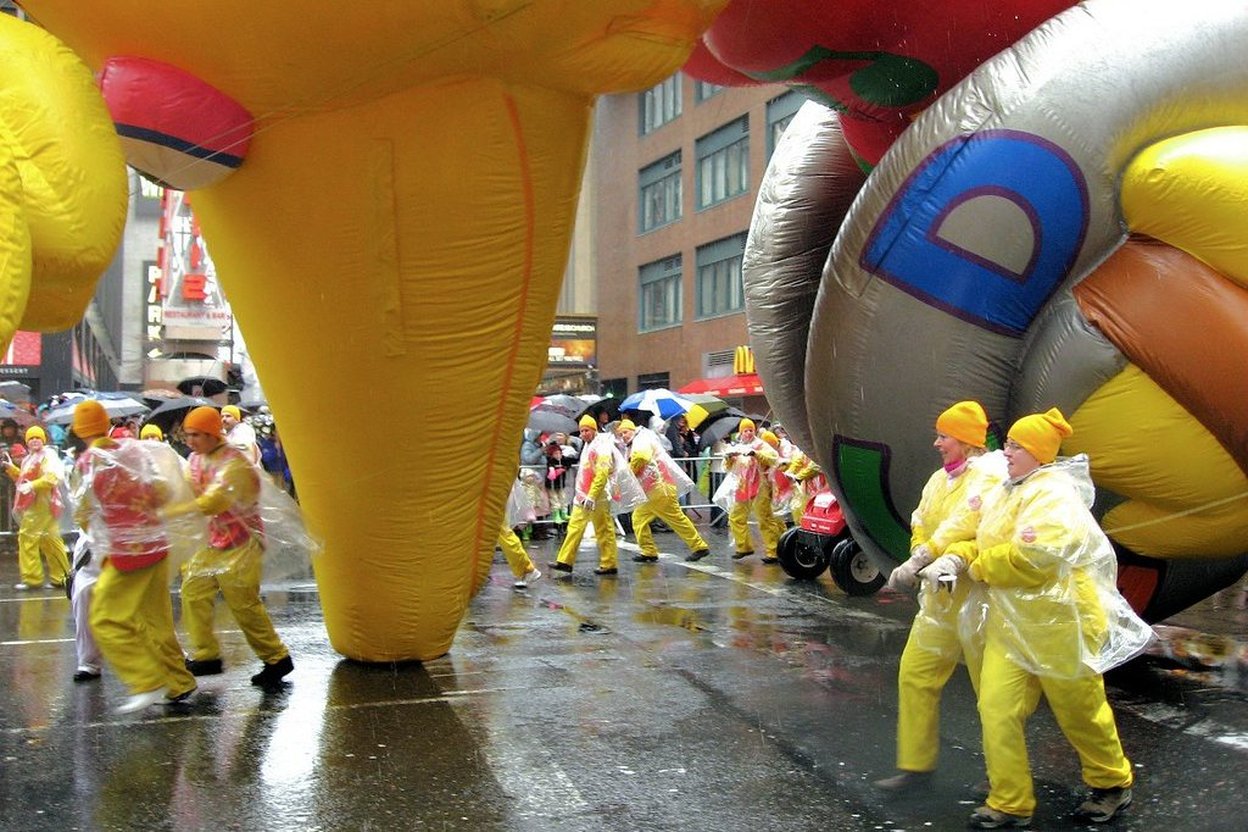
Photo: ATTACK OF THE 50 FOOT BIRD by joiseyshowaa, BY-SA 2.0.