Why Do the Lions and Cowboys Always Play on Thanksgiving? Two Owners Who Wanted Attention
Learn why the Lions and Cowboys host permanent Thanksgiving NFL games—a publicity stunt by their owners that became tradition.
You've eaten too much turkey, someone has the remote, and the TV is showing the Detroit Lions, just like last year. A few hours later it's the Dallas Cowboys, also like last year. The reason is simple. Each team asked for that spot decades ago to sell tickets and get noticed. Both games worked well enough that the NFL kept them, and over time they became a holiday tradition.
The short answer
Neither game started as a tradition. Both started as publicity stunts.
The Lions came first. In 1934, their new owner needed fans for a team that had just moved to the city, so he scheduled a big game on Thanksgiving and put it on national radio. Detroit has hosted a game on the holiday every year since, except for 1939 through 1944 during World War II.
The Cowboys joined in 1966. Dallas was a young franchise that wanted the whole country watching, and a holiday afternoon with no other games on was a good way to get that.
Both games drew big crowds, so the league left them on the schedule. Over the years they became as expected as the turkey. "Always" is slightly too strong, though. Detroit took six war years off, and Dallas briefly gave up its game in the 1970s. Both stories are below.
Detroit, 1934: a radio owner's gamble
In March 1934, radio executive George A. "Dick" Richards bought the Portsmouth Spartans, a small-town team from Ohio, and moved them to Detroit. They became the Lions. According to History.com and Scripps News, he wanted to boost ticket sales and get his new team noticed in a city that hadn't fully embraced it yet.
His background in radio shaped the plan. History.com reports that Richards persuaded George Halas, owner of the Chicago Bears, to bring his team to Detroit on Thanksgiving. He also got NBC Radio to carry the game nationally on 94 stations, the first national broadcast of an NFL game.
The matchup was strong. On Nov. 29, 1934, at University of Detroit Stadium, the undefeated Bears (11-0) played the Lions (10-1). Chicago won 19-16 in front of about 26,000 fans. Scripps News reports the game sold out, and people across the country heard it on the radio.
The game kept going after that. The only break came during World War II, when Detroit's Thanksgiving games stopped from 1939 to 1944. They returned in 1945 and haven't stopped since.
The sources don't record any formal decision to give Detroit the holiday permanently. The simplest explanation is that the game kept drawing crowds year after year, and nobody had a reason to change it.
Dallas, 1966: Tex Schramm wants a spotlight
About 30 years later, a different team had a similar problem. The Cowboys were still new in the mid-1960s, and general manager Tex Schramm wanted national publicity for them, according to ESPN and Scripps News. A Thanksgiving game, with millions of people home from work and school, offered exactly that.
The first one went well. On Thanksgiving 1966, Dallas beat the Cleveland Browns 26-14 at the Cotton Bowl in front of 80,259 fans, ESPN reports. That was about three times the size of Detroit's first Thanksgiving crowd.
The Cowboys didn't keep the date without interruption, though. In the mid-1970s, Commissioner Pete Rozelle gave Thanksgiving games to the St. Louis Cardinals to help make them more popular, ESPN reports. ESPN describes the experiment as a failure because the Cardinals never became a big holiday draw. Accounts generally say Dallas missed two holidays during those years, 1975 and 1977.
According to ESPN, Schramm agreed to take the game back only if it was permanent. His reasoning: "It's something you have to build as a tradition." Scripps News dates the Cowboys' permanent hold on Thanksgiving to after 1978, and Dallas has hosted every year since.
Why it stuck, and what changed
By the late 1970s, the holiday had settled into a routine: Detroit in the early afternoon, Dallas later on. Fans planned dinner around the kickoff times, and the games became part of the day the way parades and leftovers are.
For decades, the NFL kept it at two games. In 2006, the league added a third game in prime time, according to Scripps News. Unlike the other two, it has no permanent host, so the teams change every year. Last season's lineup shows how it works: Packers at Lions at 1 p.m. ET, Chiefs at Cowboys at 4:30 p.m. ET, and Bengals at Ravens at 8:20 p.m. ET, per ESPN.
Recently the NFL has stretched the holiday at both ends. This year's schedule adds a game on Thanksgiving Eve and another on Black Friday, both on streaming services. For the first time, Thanksgiving week has NFL games on four days in a row.
The Lions and Cowboys still have the two permanent slots, and the new games are built around them.
This year: Thursday, November 26, 2026
Thanksgiving falls on Nov. 26 this year. Here's the lineup, according to CBS Sports and NBC Washington. All times are Eastern.
- Wednesday, Nov. 25 (Thanksgiving Eve): Packers at Rams, 8 p.m., Netflix
- Thursday, Nov. 26: Bears at Lions, 1 p.m., CBS/Paramount+
- Thursday, Nov. 26: Eagles at Cowboys, 4:30 p.m., Fox
- Thursday, Nov. 26: Chiefs at Bills, 8:20 p.m., NBC and Peacock
- Friday, Nov. 27 (Black Friday): Broncos at Steelers, 3 p.m., Prime Video
Detroit's opponent repeats history. In 1934, Richards needed the Bears to make his first Thanksgiving game matter, and this year Chicago is back in Detroit for the early kickoff. Dallas gets a division rival in Philadelphia. The night game is Chiefs at Bills, two AFC teams that have met often in recent playoffs.
Sources (5)
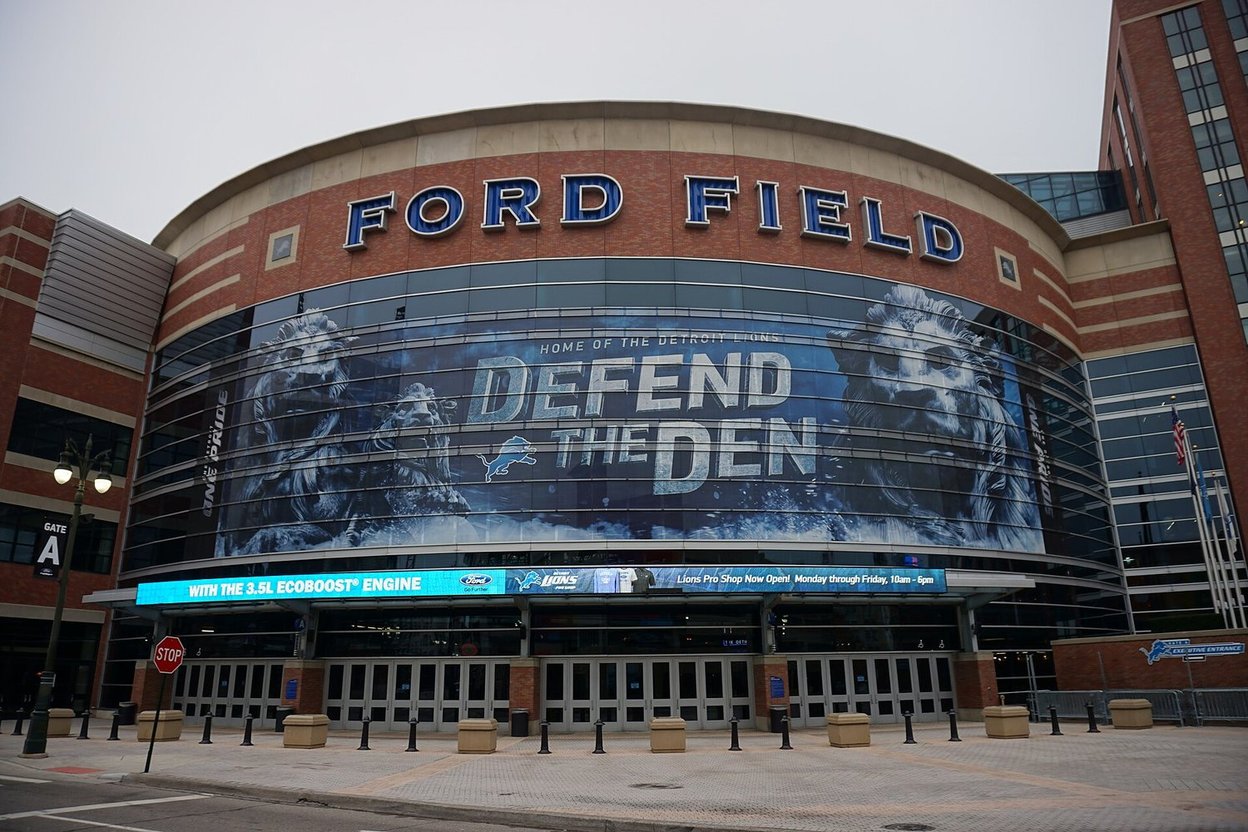
Photo: Detroit December 2015 09 (Ford Field) by Michael Barera, CC BY-SA 4.0.