Where Did Trick-or-Treating Come From? Soul Cakes, Pranks and the End of Sugar Rationing
Learn the surprising origins of trick-or-treating, from Celtic Samhain and medieval mumming through sugar rationing to today's $13.5 billion holiday tradition.
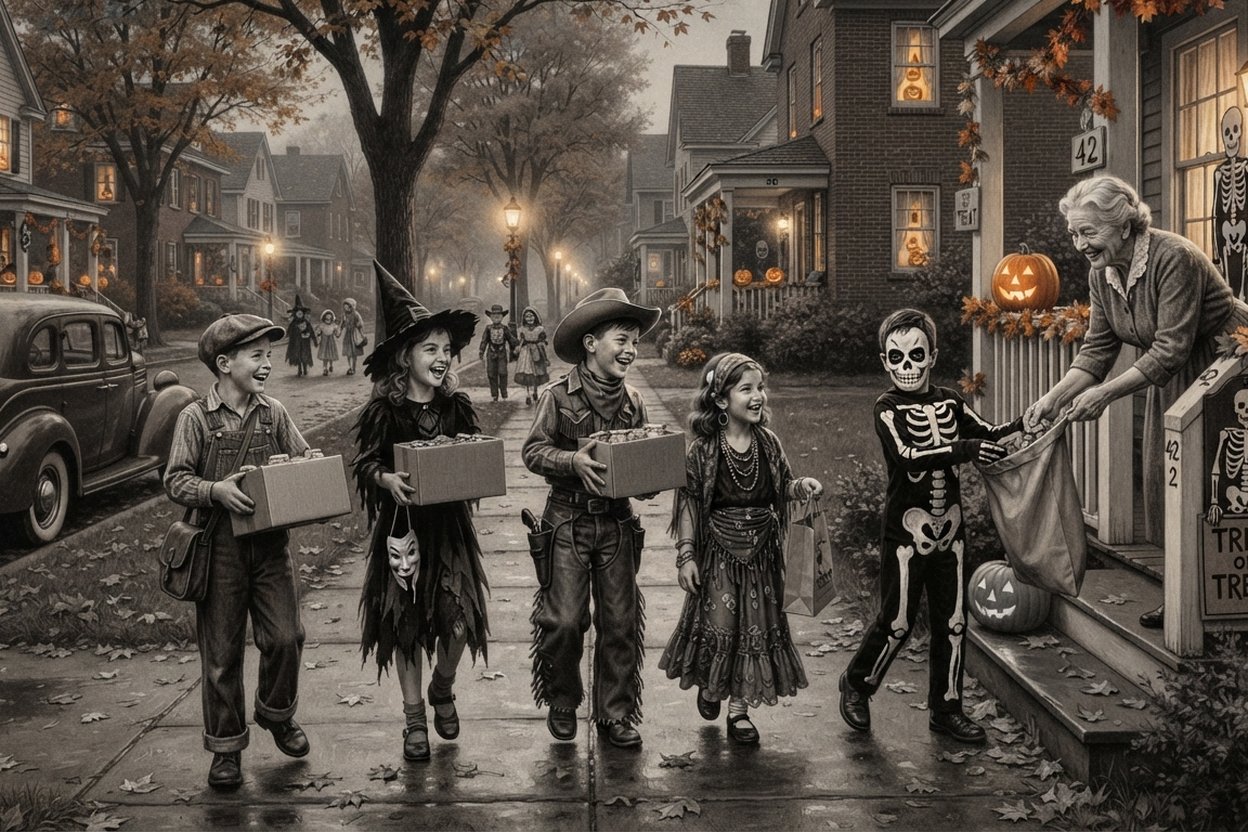
You stand at the door with a bowl of candy as a small superhero holds out a pillowcase and says the three words every child knows. That exchange is older than it looks, but it was not invented all at once. Trick-or-treating grew out of British and Irish customs in which people went door to door in costume, offered prayers or performances, and got food in return. Immigrants brought those customs to North America. Towns organized them in the 1930s, and the custom spread across the country after World War II.
The short answer
No one invented trick-or-treating on a particular date. It blends several older traditions. In medieval mumming, people performed in costume for food and drink. In souling, the poor went to wealthier homes and received "soul cakes" for promising to pray for the dead. In guising, Scottish and Irish children in costume performed a song, poem or joke for a treat. According to History.com, Irish and Scottish immigrants revived these Old World customs in the United States in the mid-1800s.
The custom as Americans now know it took shape later. During the 1930s, community leaders promoted organized trick-or-treating to rein in Halloween vandalism. The phrase "trick or treat" first appears in print in Canadian newspapers between 1917 and 1927. Wartime sugar rationing then stalled the custom. Once rationing ended in 1947, candy companies, children's magazines, UNICEF and cartoon characters helped make it a national habit.
The old roots: Samhain, mumming, souling and guising
Trick-or-treating is often traced back to Samhain, the Celtic festival held on October 31. The Celts believed the dead returned to earth that night. According to History.com, villagers wore costumes made of animal skins and left food out to appease the spirits.
How directly Samhain leads to modern trick-or-treating is uncertain. The link is traditional rather than documented, and historians disagree about how much of Halloween is Celtic and how much comes from later Christian practice. The medieval customs that followed are much easier to trace.
In the Middle Ages, mumming became popular. Costumed people went around performing in exchange for food and drink, which already looks a lot like the modern deal.
The church supplied the next piece. By the 9th century it had established All Souls' Day on November 2. Poor people went to wealthier homes and received soul cakes, small pastries given in return for a promise to pray for the household's dead. The practice was called souling.
The custom that looks most like modern trick-or-treating was guising, practiced in Scotland and Ireland. Young people dressed up and went from house to house. They had to earn their reward with a song, a poem or a joke, and in return they got fruit, nuts or coins. The costume, the door and the treat were all there. The threat had not yet arrived.
Crossing to North America
Guising and its relatives came across the Atlantic with Irish and Scottish immigrants, who kept their Halloween customs alive in the US during the 1800s. According to a second History.com article, trick-or-treating as a named practice reached North America in the 1920s and '30s and took root first in the West.
The holiday also had a rougher side. Halloween pranks were rampant in the 1920s. During the Great Depression they grew into vandalism and, sometimes, violence. Pranks that had once meant soaping a window could now mean real property damage, and towns wanted the problem gone.
The fix was to give young people something better to do. In the 1930s, community leaders promoted what History.com calls "an organized, community-based, trick-or-treating tradition." The idea was that if households greeted costumed children with treats, the children would have less reason to cause trouble. The old door-to-door custom became a way of keeping the peace.
Where the phrase "trick or treat" first shows up
The earliest printed evidence for the phrase comes from Canada. The Dictionary of Canadianisms on Historical Principles at the University of British Columbia lists early examples:
- 1898: An article in the Vancouver Daily World describes young people visiting homes in disguise on Halloween. It describes the custom but does not use the phrase.
- 1917: The Sault Star in Sault Ste. Marie, Ontario, prints "tricks or treats." The same year, the Owen Sound Sun prints "treat or trick."
- 1924: A Prairie source records "treat up — or tricks."
- 1927: The standard form, "trick or treat," appears in print in Alberta.
Sources disagree about which Alberta newspaper printed it first, so the safest statement is simply Alberta, 1927.
The word order changed for about a decade before it settled, but the meaning stayed the same. The "trick" was the prank a household could expect if it didn't hand over a "treat." Today, "trick or treat" is a cheerful greeting. When the phrase first appeared, it was a mild threat.
Sugar rationing, then the postwar boom
Just as the custom was catching on, World War II interrupted it. According to History.com, US sugar rationing began on May 4, 1942, with a limit of half a pound per person per week, about 50 percent below prewar levels. Treats were scarce, and trick-or-treating stalled.
Sugar rationing ended in June 1947, and businesses moved quickly. History.com reports that candy makers such as Curtiss and Brach ran Halloween campaigns. That fall, the children's magazines Jack and Jill and Children's Activities published trick-or-treating content, which introduced the custom to children who might never have tried it.
More boosts followed:
- 1950: UNICEF launched a national campaign that gave children cardboard collection boxes so they could gather coins along with their candy.
- 1951: Peanuts ran three Halloween strips from October 29 to 31.
- 1952: Disney released the short Donald Duck – Trick or Treat. History.com says that by then the custom was "firmly established."
In about five years, trick-or-treating went from a regional habit slowed by war to something children everywhere expected each October 31. The postwar baby boom and growing suburbs gave it plenty of children and plenty of doors.
Trick-or-treating today
Seven decades later, the custom is big business. The National Retail Federation's 2026 survey of 7,889 consumers, conducted September 1–9, projects record Halloween spending of $13.5 billion. According to the survey:
- 74% of consumers plan to celebrate Halloween.
- Average spending is $115.14 per person.
- Candy is the top purchase: 96% plan to buy it, for a total of about $4.1 billion.
- Handing out candy is the most popular activity, at 61%, ahead of dressing in costume (50%) and decorating (42%).
When someone rings your doorbell this October 31, the exchange follows an old pattern. A costumed visitor offers a song, a prayer or a threat of a prank, and the household pays in food. The soul cake has been replaced by a fun-size candy bar.
Sources (5)
- History.com: The History of Trick-or-Treating
- History.com: How Donald Duck and Peanuts Saved Trick-or-Treating
- Dictionary of Canadianisms on Historical Principles (UBC): "trick or treat"
- National Retail Federation: Halloween Data and Trends
- NRF press release: Halloween survey shows consumer spending expected to reach $13.5 billion