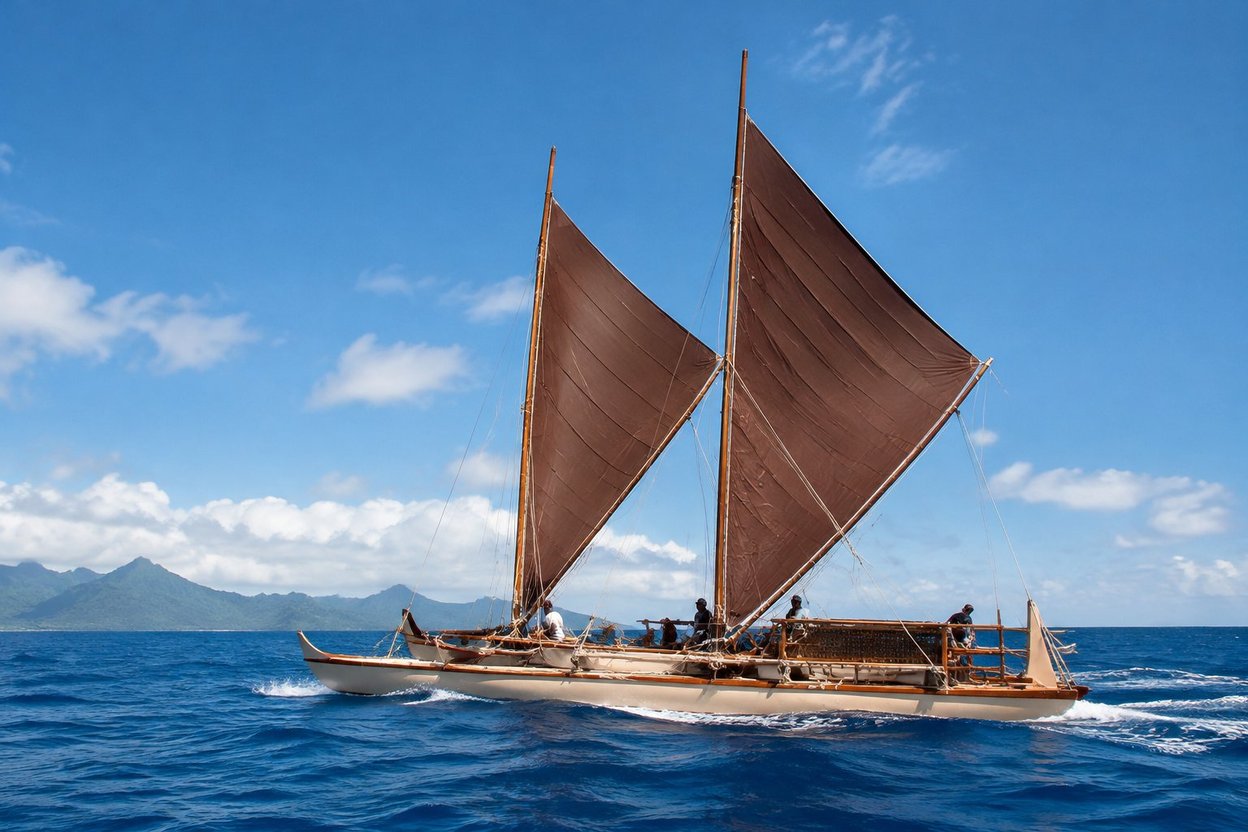
Did Easter Island Seafarers Settle Hawaii? What the New DNA Study Shows, and What It Doesn't
A new Science study links Native Hawaiians to Rapa Nui through DNA. Here's what it shows, what it doesn't, and what stays open.
If you've ever opened a DNA-kit result and found your closest match living somewhere you didn't expect, you already understand this study's headline. Researchers compared genomes from across Polynesia and found that Native Hawaiians share more Polynesian ancestry with the people of Rapa Nui (Easter Island) than with any other island population they sampled. Rapa Nui is more than 4,400 miles from Hawaiʻi. The DNA does show a close family connection. It doesn't prove that a canoe sailed straight from Easter Island and founded Hawaiʻi. That part is still an interpretation.
The study at a glance
- Title: "Message in a bottleneck: Nested founder effects from French Polynesia to Rapa Nui and Hawaiʻi"
- Journal: Science, published October 8, 2026
- Co-senior authors: Stanford geneticist Alexander Ioannidis and UC San Diego anthropologist Keolu Fox, who is Native Hawaiian
- Data: whole-genome sequences from 1,050 people across Polynesia, according to UC San Diego
- Key sample sizes, as reported by Reuters: 317 Native Hawaiians, 12 Rapa Nui and 8 Mangarevans
- Other populations sampled: the Society, Tuamotu, Marquesas, Austral, Samoan and Tongan islands
- Type of DNA: genomes of people living today, not excavated ancient remains
That last point matters because some headlines call this an "ancient DNA" study. It isn't one. It reconstructs ancient population history from the DNA of living people. Studies that sequence old skeletons are a separate kind of research.
The sample sizes also matter. More than 300 Native Hawaiians is a solid group. Twelve Rapa Nui and eight Mangarevan participants are much smaller groups, so those populations rest on a thin slice of people.
How the researchers read the DNA
Many Polynesians today also have European, Asian or other ancestry from the last few centuries. The researchers isolated the Polynesian stretches of each genome and set the more recent contributions aside, according to Stanford Medicine.
Next they compared "identity-by-descent" segments. These are stretches of chromosome that two people inherited from the same ancestor. Every generation shuffles DNA and cuts those stretches shorter. Long shared segments therefore point to a recent common ancestor, and short ones point further back.
In an interview with Honolulu Civil Beat, Fox described four separate checks:
- Gene frequencies: how common particular variants are in each population
- Total shared DNA: how much of the genome two populations share by descent
- Average segment length: how long those shared stretches tend to be
- Resampled genetic trees: rebuilding the family tree of populations over and over to see how stable each pairing is
All four checks pointed the same way. Among the populations compared, Hawaiʻi's closest Polynesian relative was Rapa Nui, with Mangareva second.
What the 61% figure actually means
The most-quoted number from the study is easy to misread. The researchers rebuilt the population tree 2,500 times. Hawaiʻi and Rapa Nui came out as each other's closest branch in 61% of those trees. Mangareva took that spot about 10% of the time, and the Marquesas less than 3%.
That number measures how consistently the analysis puts Hawaiʻi and Rapa Nui together. It is not an ancestry percentage. It doesn't mean Native Hawaiians are "61% Rapa Nui." A useful comparison is a poll in which 61% of reruns name the same winner. That tells you how confident to be, not how large the win was.
Observation, interpretation, open question
Coverage of this study often mixes three different things together. Here they are separately.
What the DNA shows - Native Hawaiians share more Polynesian ancestry with Rapa Nui than with any other sampled population. - Mangareva is the next closest. - The Hawaiʻi and Rapa Nui pairing held up in 61% of 2,500 reconstructed trees.
How researchers interpret it - Reuters reports Ioannidis's reading: settlers reached Rapa Nui from Mangareva in the 1200s, and a subset of them went on to Hawaiʻi that same century. - UC San Diego describes ancestry rooted in Mangareva and repeated movement between islands rather than a single one-way migration. The researchers call this proposed voyaging tradition Holomoana Nui, meaning "great ocean voyaging."
What remains unresolved - Fox told Civil Beat that the genome can't establish which island settled which, and can't reconstruct the voyages that came afterward. - So a direct Rapa Nui-to-Hawaiʻi founding voyage is one reading of the data. Another is that both islands were settled from the same seafaring population, with people coming and going over time.
The two readings differ on routes and order. Neither one questions that Polynesian navigators settled these islands on purpose, across thousands of miles of open ocean.
Getting the map right
Mangareva, in southeastern French Polynesia, lies west of Rapa Nui. That puts it between the central Polynesian islands and Easter Island, and it explains why it keeps appearing as the stepping stone in both studies. Hawaiʻi lies far to the north of both.
Any route drawn between these islands is a hypothesis about where people sailed. The genomes show who is related to whom. They don't record the sailing route.
A short timeline
- September 22, 2021: A predecessor study analyzed 430 living people from 21 Pacific island populations. It inferred that Rapa Nui was settled around AD 1200 by way of Mangareva.
- 2021 reaction: Archaeologist Patrick Kirch, quoted by Science News, questioned that earlier work. He stressed that islands stayed in contact with each other and that evidence beyond genes matters. His comments concerned the 2021 paper, not the new one.
- October 8, 2026: The new Science study added a much larger set of genomes, including Native Hawaiians, and found the close Hawaiʻi and Rapa Nui relationship.
- Reuters' interpretation: Ioannidis places the Rapa Nui settlement and a later voyage to Hawaiʻi in the 1200s.
One search-result trap: a Science News article ranking alongside the new coverage dates from September 2021. It covers the earlier paper, not this one.
Box: How many people founded Tahiti?
The study also reconstructed Tahiti's founding. It estimated about 800 founders around the year 1070, according to Stanford Medicine. That figure counts reproductive-age people in the founding generation. It leaves out the children and elders who would have traveled or lived with them, so the real number of people present was larger.
Fox told Civil Beat that this reconstruction used 581 genomes and assumed a generation length of 28 years. This estimate applies to Tahiti only. It shouldn't be used as a founder count for Hawaiʻi or Rapa Nui.
Why "bottleneck" is in the title
When a small group settles a new island, it carries only part of the genetic variety of the population it left behind. That is a founder effect. When a group from that settlement moves on to found yet another island, the effect compounds. The study's title calls these "nested" founder effects, one bottleneck inside another, moving outward from French Polynesia.
This affects health. A variant that was rare in a large population can become more common after several bottlenecks. The researchers investigated recessive variants in three genes:
- ADAMTSL4, associated with dislocation of the eye's lens
- PDE6B, associated with progressive vision loss
- FAN1, associated with kidney failure
"Recessive" means a person generally needs two copies of the variant, one from each parent, to be affected. Someone with a single copy is a carrier.
Published sources disagree on how common the FAN1 variant is, and Fox said there weren't enough Native Hawaiian data to report reliable disease-variant frequencies for Hawaiʻi. The findings come mainly from French Polynesian populations and can't be read as Hawaiian rates. The study also sets no clinical guidelines and offers no treatments. Anyone with questions about their own risk should take them to a doctor or genetic counselor, not to a news headline.
Who benefits from the research
Genetic research has a difficult history with Indigenous communities, and this team addressed that directly. Fox has emphasized research that is useful to the communities involved and community authority over genetic data. UC San Diego reports that the company Variant Bio has committed 4% of revenue and 4% of equity-derived value to partner communities.
What readers are still asking
Discussion threads after the news show two main kinds of question. On r/Hawaii, readers asked how the findings fit with Hawaiian settlement traditions and with later migrations from Tahiti and the Marquesas. On r/science, commenters questioned the jump from "closely related" to "sailed directly." Both are fair questions, and the study's own authors don't settle either one.
The bottom line
Native Hawaiians' closest Polynesian relatives, among the populations sampled, live 4,400 miles away on Rapa Nui. Four separate genetic checks support that connection. The connection runs back through Mangareva, and it fits a picture of skilled navigators moving repeatedly across the eastern Pacific around 900 years ago. Whether one canoe sailed from Easter Island to found Hawaiʻi is a different question. That one is still open.
Sources (9)
- UC San Diego Today: Polynesian wayfinding is written in the genomes of island populations
- Stanford Medicine: Hawaiian genetics study
- KSL (Reuters): Genetic study shows seafarers from Easter Island settled Hawaii
- Honolulu Civil Beat: Native Hawaiians didn't descend from where you may think
- PubMed: 2021 predecessor study
- Science News (2021): DNA offers a new look at how Polynesia was settled
- SciTechDaily: A 1,000-year-old DNA mystery links Hawaii and Easter Island
- r/Hawaii discussion
- r/science discussion