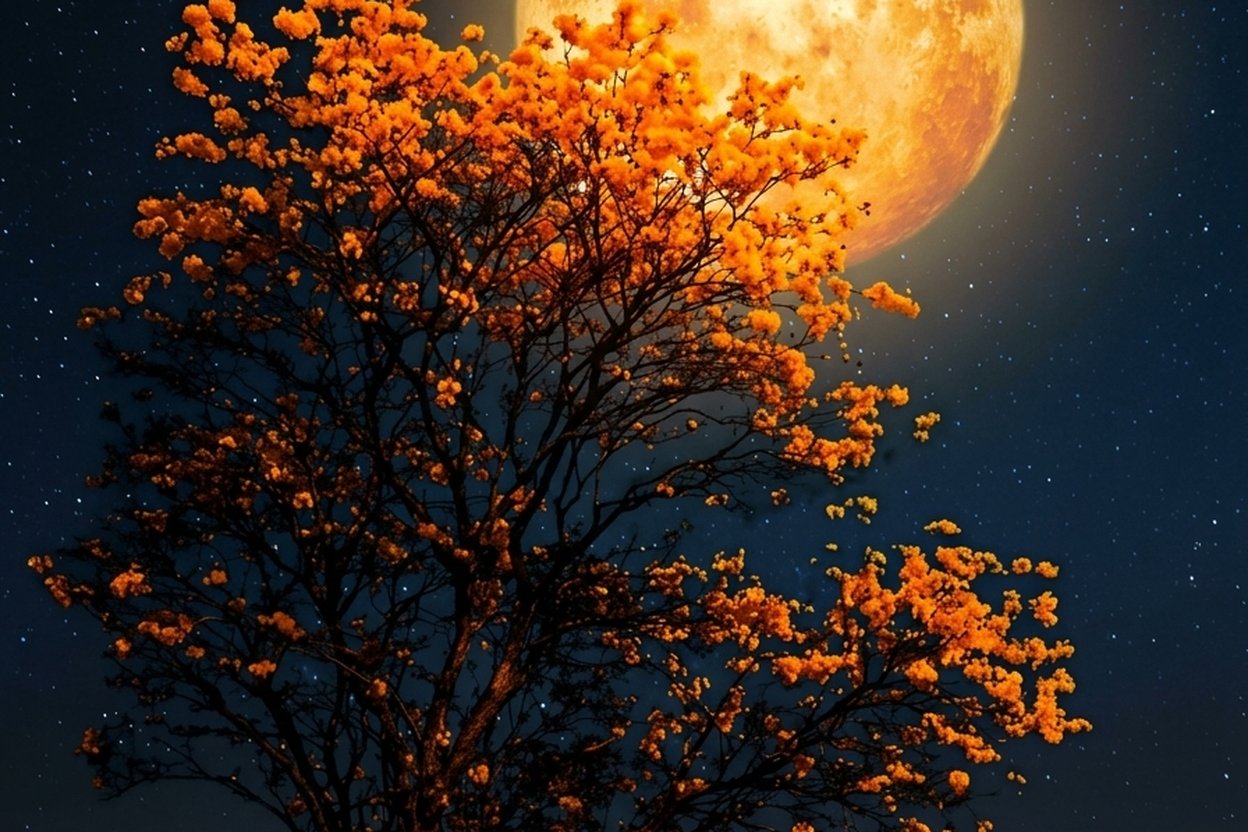
The Hunter's Moon: why October's full moon has a hunting name
Discover why the October full moon is called the Hunter's Moon, its rich history, and when to see it in 2026.
You step outside on a cool October evening and there it is: a big orange moon sitting low over the rooftops, up almost as soon as the sun goes down. If someone has called it the "Hunter's Moon," the name comes from a simple rule and an old seasonal job. The Hunter's Moon is the first full moon after the Harvest Moon. It got its name because late autumn was hunting season: the fields were bare, the game was fat, and the moon gave extra light after dusk.
The short answer
In 2026 the Hunter's Moon reaches full on Monday, October 26, at 12:12 a.m. EDT (04:12 UTC), according to the Farmers' Almanac and Almanac.com. That moment falls just after midnight on the East Coast, so for most of the United States the best time to look is the evening of Sunday, October 25, when the moon rises in the east around sunset.
The name follows a rule. The Hunter's Moon is the full moon that comes after the Harvest Moon, and in most years that puts it in October. Both almanacs tie the name to the work of the season. By the time this moon arrived, the crops were in, and the next job was hunting and preparing meat for winter.
That leaves two questions: what decides which moon counts as the Harvest Moon, and why hunters cared about this one in particular. The answer to both is in the sky as much as on the farm.
The Harvest Moon rule
The Hunter's Moon is defined by the Harvest Moon, so start there. The Harvest Moon is the full moon closest to the autumn equinox, which falls around September 22–23. The Hunter's Moon is simply the next full moon after it.
In 2026 the Harvest Moon was the full moon of September 26, according to the Farmers' Almanac. That makes the October 26 full moon the Hunter's Moon.
Because the name is set by the equinox and not by the calendar month, it moves around:
- Usually October. In most years, the full moon closest to the equinox lands in September and the next one lands in October.
- Sometimes November. If the full moon closest to the equinox falls in early October, that October moon becomes the Harvest Moon. Almanac.com says September's full moon then goes by the Corn Moon, and the Hunter's Moon moves to November. Universe Today puts this at roughly once every four years.
So "October full moon" and "Hunter's Moon" usually mean the same thing, but not always. Checking which full moon sat closest to the equinox tells you which one gets the name.
Why autumn hunters wanted this moon
Picture the countryside in late October before modern farming. The grain has been cut and carried off the fields. What's left is stubble and spilled seed, and the animals have been feeding on those leftovers for weeks. The Farmers' Almanac and Almanac.com both describe it the same way: deer, foxes and turkeys are well fed by late autumn, and they are easier to spot in open, cleared fields than they were in the high crops of summer.
Timing mattered too. Winter was coming, and meat had to be hunted, butchered and preserved while the weather allowed it. The bright moon rising soon after sunset gave hunters extra light in the evening to track game and keep stocking food.
The way this moon rises also helps. On average, the moon rises about 50 minutes later each night. Around the Harvest and Hunter's Moons, that delay shrinks to about 30 minutes at northern mid-latitudes, according to Universe Today. The reason is geometry. On autumn evenings, the moon's path across the sky (which runs close to the ecliptic, the plane of Earth's orbit) meets the eastern horizon at a shallow angle. From one night to the next, the moon moves along that low, slanting path and doesn't sink much farther below the horizon, so it doesn't take much longer to come up.
The result is several evenings in a row when a nearly full moon is already up at dusk or soon after. There is no long dark gap between sunset and moonrise. For anyone working outdoors without electric light, that was useful.
Where the name came from
The name is old, but how old, and from whom, depends on which source you read.
The earliest written record. According to the Farmers' Almanac, as quoted by other outlets, the earliest use of "Hunter's Moon" cited in the Oxford English Dictionary dates to 1710. That puts the phrase in English more than three centuries ago.
European roots. The Farmers' Almanac links the name to Anglo-Saxon tradition, in which this moon marked the start of the hunting season. That fits the farming calendar described above: harvest first, then the hunt.
Native American names. Many Indigenous peoples of North America named the moons by what was happening around them, and the October moon has several names. Almanac.com lists:
- Drying Rice Moon (Dakota)
- Falling Leaves Moon (Anishinaabe)
- Freezing Moon (Ojibwe and Haida)
- Migrating Moon (Cree)
The Farmers' Almanac has its own list, including Hunting Moon, Falling Leaves Moon and Moon the Birds Fly South. It credits some of these names to different peoples than Almanac.com does. Those names reach most readers through almanac publishers, and the two almanacs don't agree on which nation used which name. The safe reading is that these are names attributed to Indigenous peoples by these publications, not a settled record.
The bottom line on origins: the sources disagree. The Farmers' Almanac points to Anglo-Saxon tradition, and Universe Today credits the First Nations of North America. Both may be partly right, since farming and hunting peoples on both sides of the Atlantic had the same seasonal reasons to notice this moon. No single origin is proven.
Myths and what to expect in 2026
Myth: the Hunter's Moon is bigger or brighter than other full moons. It isn't. Universe Today notes that it is generally no larger or brighter than any other full moon. The only thing that sets it apart is the short gap between sunset and moonrise on the nights around it.
Why it looks so big and orange anyway. You usually see it near the horizon, right after it rises. Low in the sky, the moon's light passes through more air, which gives it a warm color, and a moon next to trees and rooftops tends to look bigger than one high overhead. It is the same moon as any other month. You are just more likely to catch it at its most photogenic moment.
When to look in 2026:
- Exact full moon: Monday, October 26, 2026, at 12:12 a.m. EDT (04:12 UTC).
- Best evening: Sunday, October 25. Face east around sunset and watch it come up.
- Second chance: Because of the short moonrise delay, the moon will still look full and rise early on the evening of Monday the 26th.
That is less than a week before Halloween, so the Hunter's Moon is close to being this year's Halloween moon. Unlike the hunters it was named for, you only need a clear eastern horizon and a few minutes after sunset.