When does the Hunter's Moon peak in October 2026?
Find out when the 2026 Hunter's Moon peaks, why the date changes by time zone, and where to look on the evening of Oct. 25.
You may check the sky after sunset and see a bright moon before its exact full-moon moment arrives. The Hunter’s Moon peaks at 12:12 a.m. EDT on Monday, Oct. 26, 2026. Across most of the country, that moment falls on Sunday night, Oct. 25.
Your local date depends on your time zone: the peak comes before midnight in Central, Mountain and Pacific time. The moon will still look full on the nights around the peak, so you have more than one chance to see it.
The short answer: 12:12 a.m. EDT Monday, Oct. 26, which is Sunday night for most of the country
The Hunter’s Moon reaches its full phase at 12:12 a.m. EDT on Monday, Oct. 26, 2026. The U.S. Naval Observatory lists the exact moment as 04:12 UTC on Oct. 26 in its 2026 moon-phase data.
That same instant is 11:12 p.m. CDT, 10:12 p.m. MDT and 9:12 p.m. PDT on Sunday, Oct. 25. If you live in the Eastern time zone, the calendar date is Monday; across the Central, Mountain and Pacific time zones, it is Sunday.
The moon’s phase changes at one instant worldwide, while local clocks show different dates and times. That distinction explains why you may see Oct. 25 or Oct. 26 listed for the Hunter’s Moon. Both dates refer to the same peak, expressed in different time zones.
When and where to look
Look east around sunset on Sunday, Oct. 25, when the moon rises close to its full phase.
You can check the U.S. Naval Observatory’s daily data for New York, Chicago, Denver and Los Angeles.
The moon looks full to your eyes for a night on either side of the exact peak. If clouds or your schedule interfere on Sunday, Monday evening remains a good time to see a nearly full moon. For the easiest view, find a spot with a clear eastern horizon and begin looking around sunset.
Hunter's Moon or Harvest Moon?
October’s full moon is correctly called the Hunter’s Moon in 2026 because September’s full moon is the Harvest Moon. The Harvest Moon is the full moon closest to the autumn equinox, which occurs on Sept. 22 in Eastern time this year.
The full moon on Sept. 26 is closer to that equinox than the Oct. 26 full moon, so it receives the Harvest Moon name. October’s full moon follows as the Hunter’s Moon.
The names can switch from year to year. When October’s full moon falls closer to the autumn equinox than September’s, October’s moon is the Harvest Moon instead. The name therefore follows the full moon nearest the equinox, not a fixed month.
Is it a supermoon? No
The Hunter’s Moon on Oct. 26, 2026, is not one of the year’s supermoons. The 2026 supermoons fall on Jan. 3, Nov. 24 and Dec. 23.
One common definition calls a full moon a supermoon when it occurs within 90% of the Moon’s closest approach to Earth, known as perigee. Some calendars use different criteria or label the dates differently, so supermoon lists can vary. October’s full moon is absent from the three dates listed for 2026.
Where the name comes from
The Hunter’s Moon name reflects the time of year when harvest is in, fields are bare, and well-fed animals are easier to spot. Bright moonlight after sunset gave hunters extra time to see across open ground.
October has other traditional full-moon names, including the Travel Moon, Dying Grass Moon and Falling Leaves Moon. These names describe seasonal conditions associated with the month, though the Hunter’s Moon is the familiar name for October’s full moon in 2026.
What else is in the October sky
The Orionid meteor shower peaks on the night of Oct. 21–22, though a bright waxing gibbous moon will interfere with viewing. Its light makes fainter meteors harder to see.
October 2026 has no eclipse. By Halloween, the moon will be waning and past full, so it will look different from the bright Hunter’s Moon earlier in the week. The next full moon to fall on Halloween arrives in 2039.
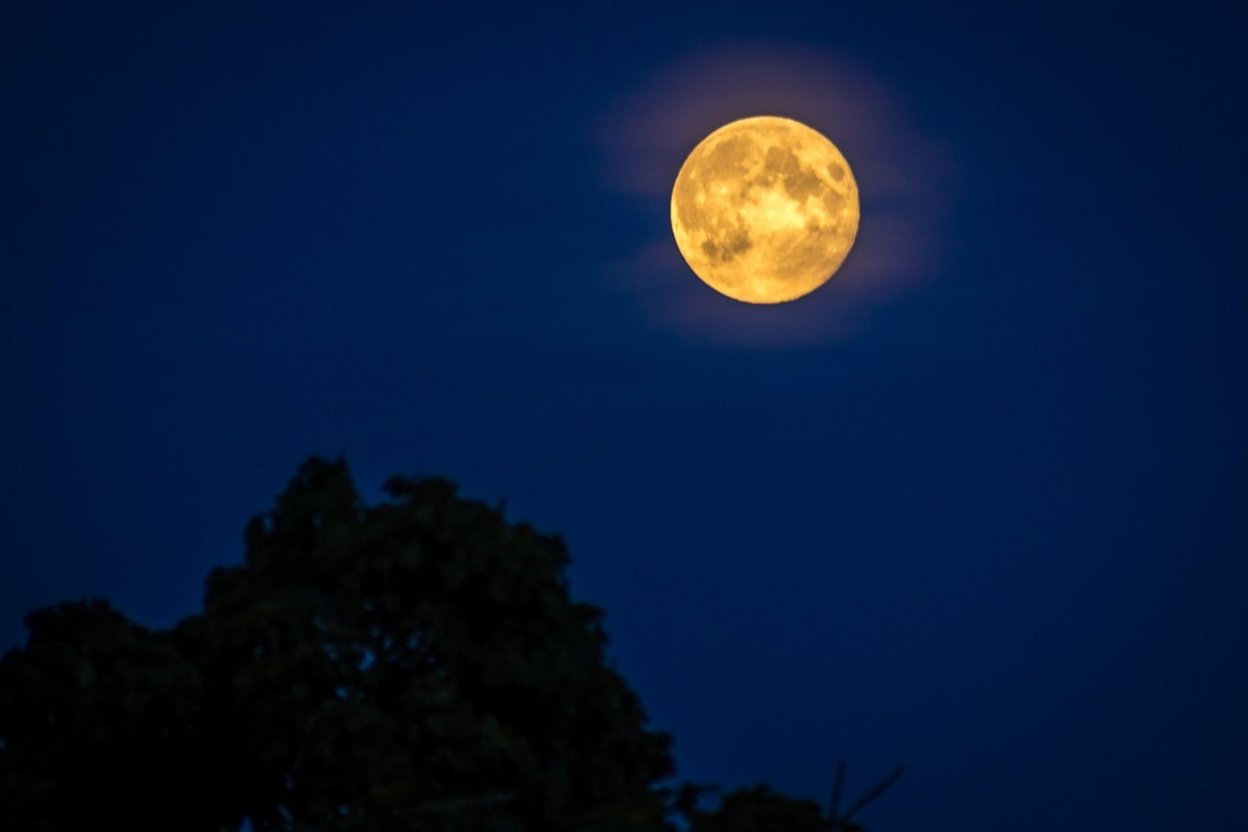
Photo: Moon over treeline (9572152030) by Tomi Lattu, CC BY 2.0.