Why Thanksgiving Moves Around the Calendar (and the Year It Moved Twice)
Learn why Thanksgiving moves around November—and the presidential controversy that convinced Congress to finally fix the date in 1941.
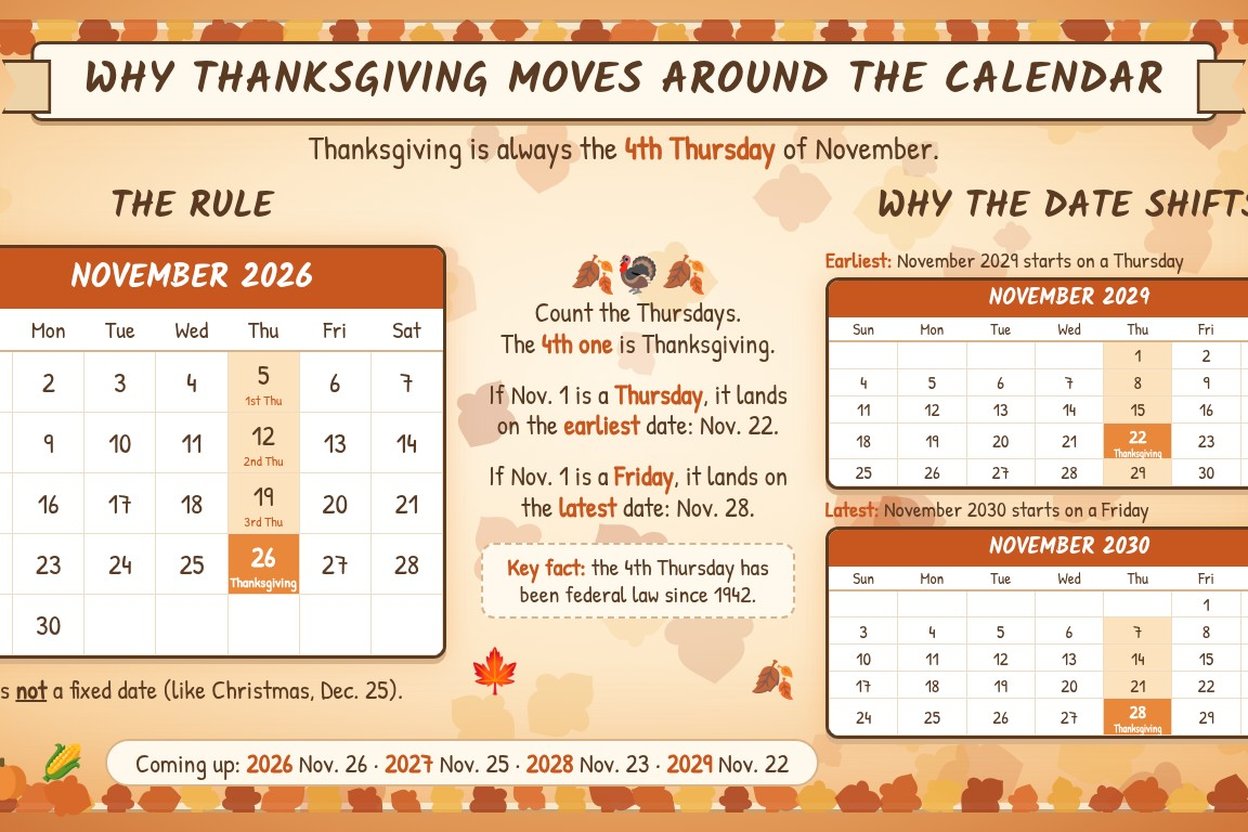
You open the calendar to book flights home, or to tell your relatives when to show up, and there's Thanksgiving: Nov. 26 this year, when you'd swear it was a few days earlier last year. That's not a mistake. Federal law doesn't give Thanksgiving a fixed date. It sets the holiday on the fourth Thursday of November. That rule exists because of a fight in 1939, when a president moved the holiday and about half the country refused to move with him.
The short answer
Under federal law, 5 U.S.C. § 6103, Thanksgiving Day is "the fourth Thursday in November." The date changes because the day of the week that November starts on changes from year to year.
Here's how the calendar works out. If November 1 is a Thursday, the fourth Thursday is Nov. 22. That's the earliest Thanksgiving can be. If November 1 is a Friday, the first Thursday is Nov. 7 and the fourth is Nov. 28. That's the latest it can be. Every Thanksgiving falls somewhere in that seven-day window, from Nov. 22 to Nov. 28.
In 2026, November begins on a Sunday. The Thursdays are Nov. 5, 12, 19 and 26, so Thanksgiving is Thursday, Nov. 26. The U.S. Office of Personnel Management lists the same date on its federal holiday schedule.
Many people think of Thanksgiving as "the last Thursday in November." Most years that gives the same answer, but not every year. Some Novembers have five Thursdays, and in those years the last Thursday and the fourth Thursday are a week apart. That gap is where the story starts.
Before there was a rule
For most of American history, nobody set Thanksgiving by a formula. A person chose the date.
On Oct. 3, 1789, President George Washington issued a proclamation naming Thursday, Nov. 26, 1789, as a day of public thanksgiving and prayer. The National Archives describes it as the first thanksgiving celebrated under the new Constitution. It was a one-time proclamation, not a yearly holiday. After Washington, presidents proclaimed thanksgiving days when they chose to, on dates they chose.
That changed during the Civil War. On Oct. 3, 1863, exactly 74 years after Washington's proclamation, President Abraham Lincoln proclaimed that Thanksgiving would be observed on the last Thursday of November. Later presidents kept that date, and "last Thursday" became the tradition for the next 75 years.
Congress stepped in partway. In 1870 it made Thanksgiving a holiday in the District of Columbia, along with Christmas, New Year's Day and Independence Day. The other three holidays had fixed calendar dates. Thanksgiving did not. According to the National Archives, the law left the date to the president.
So in 1870 the date still depended on a presidential proclamation, and the custom of the last Thursday was not written into law. That arrangement held until a president decided to break the custom.
Franksgiving, 1939
In 1939, November began on a Wednesday. Its Thursdays were Nov. 2, 9, 16, 23 and 30. Under Lincoln's tradition, Thanksgiving would land on Nov. 30, the last day of the month, leaving only a few weeks between Thanksgiving and Christmas.
At the time, the holiday shopping season was understood to start after Thanksgiving. According to the National Archives, business leaders lobbied President Franklin D. Roosevelt to move the holiday earlier and give stores more shopping days before Christmas. Roosevelt agreed. He proclaimed Thanksgiving for the second-to-last Thursday, Nov. 23, a week earlier than expected.
The change caused confusion. Calendars had already been printed. Families had made plans. Governors, who issued their own Thanksgiving proclamations, didn't all go along. Some states adopted Roosevelt's date and some kept the traditional one. A few observed both.
Sources give different counts of how the states split. The National Conference of State Legislatures puts it at 22 states for the new date, 23 for the old one, and three that celebrated both. Whatever the exact count, the country was divided roughly in half. In some places neighbors, or people across a state line, celebrated a week apart.
The early date got a nickname: "Franksgiving." The name is credited to Atlantic City mayor Charles D. White, and it stuck. Roosevelt also set the earlier date in 1940 and 1941, so the split lasted several years.
Congress fixes the date, 1941
Congress settled the question. On Oct. 6, 1941, the House of Representatives passed a joint resolution, H.J. Res. 41, setting Thanksgiving on the last Thursday of November. That would have written Lincoln's tradition into law and ended presidential discretion over the date.
The Senate changed one word. It amended "last Thursday" to "fourth Thursday." According to the National Archives and the Congressional Research Service, the reason was the five-Thursday Novembers, the kind of year that had started the dispute in 1939.
Here's why the word matters. In a November with four Thursdays, the fourth Thursday is also the last one, so the two rules agree. In a November with five Thursdays, the last Thursday falls on Nov. 29 or 30, and the fourth Thursday comes a week earlier. A "last Thursday" rule would sometimes push Thanksgiving to the very end of the month. A "fourth Thursday" rule keeps it between Nov. 22 and 28 every year.
In the five-Thursday years, the Senate's version gives roughly what Roosevelt had wanted: a Thanksgiving that never falls on Nov. 29 or 30. Roosevelt signed the amended resolution on Dec. 26, 1941. The fourth Thursday became federal law, starting with Thanksgiving 1942.
How it works today
The 1941 rule is still in effect. It's now part of 5 U.S.C. § 6103, the section of the U.S. Code that lists the legal public holidays for federal employees. Thanksgiving appears there as the fourth Thursday in November, alongside fixed dates such as Independence Day and Christmas.
That means you can work out any year's Thanksgiving yourself: find the first Thursday of November and add three weeks. It will always fall between Nov. 22 and Nov. 28. The next few dates, which match OPM's published holiday schedule:
- 2026: Thursday, Nov. 26
- 2027: Thursday, Nov. 25
- 2028: Thursday, Nov. 23 (a five-Thursday November; the old "last Thursday" rule would have put it on Nov. 30)
- 2029: Thursday, Nov. 22, the earliest possible date
The federal statute covers federal employees and federal holidays. Each state sets its own state holidays under its own laws, and that's a separate question from the federal rule. In practice, the federal date is the one that appears on calendars nationwide. After Halloween on Oct. 31, it's about four weeks until this year's Thanksgiving on Nov. 26.
Sources (6)
- U.S. Code, 5 U.S.C. § 6103 (govinfo)
- Congressional Research Service, "Federal Holidays: Evolution and Current Practices" (R44279)
- National Archives, Prologue blog: "Thanksgiving as a Federal Holiday"
- U.S. Office of Personnel Management: Federal Holidays
- National Conference of State Legislatures: "Two Thanksgivings, One Decision That Divided the Nation"
- Wikipedia: Franksgiving