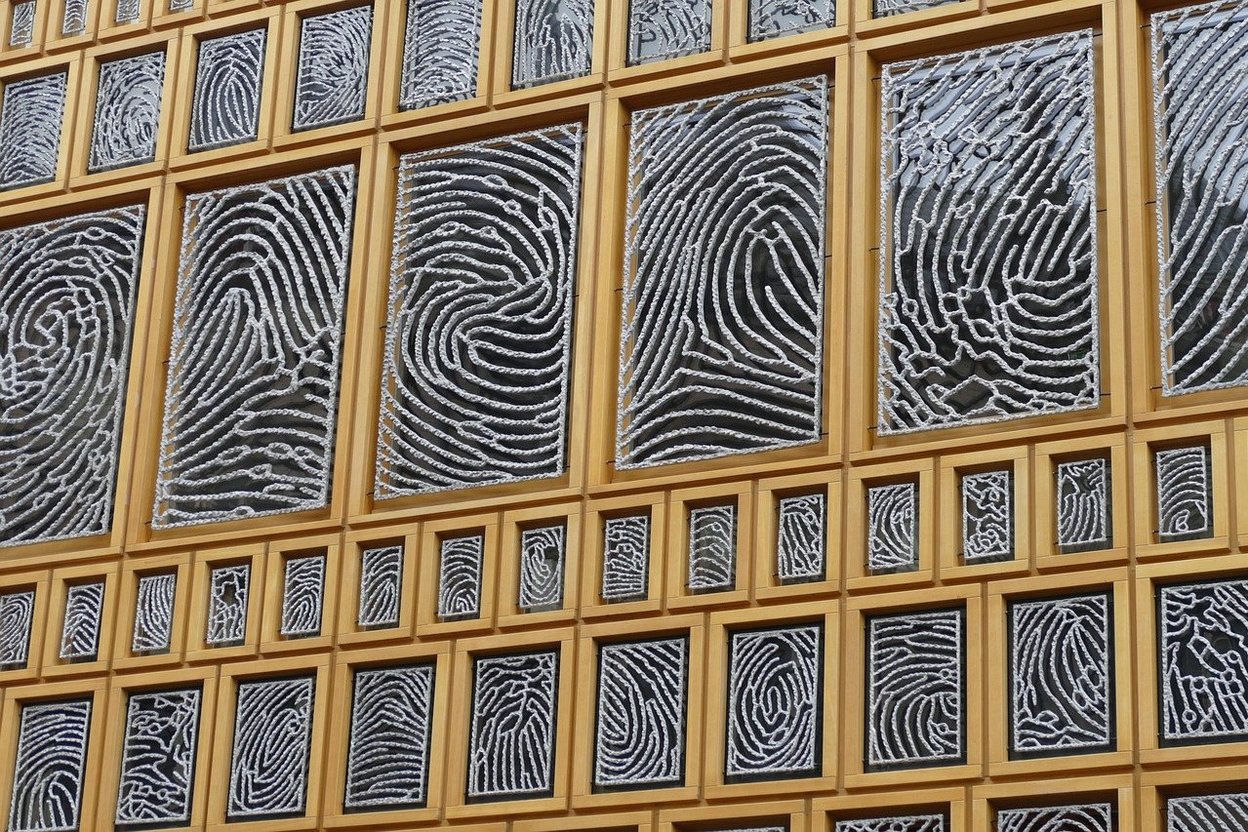
Can Identical Twins Have Different Fingerprints?
Identical twins have different fingerprints. Learn how prints form in the womb, how alike they are, and whether scanners can tell twins apart.
You probably unlock your phone with your thumb without thinking about it. Now picture handing that phone to an identical twin. People call identical twins "genetic copies," so you might expect the sensor to open for them too. It won't. Identical twins have different fingerprints. Their prints are often alike in the overall shape, but the fine detail is their own. Here is why, how alike the prints really are, and whether a scanner or a trained examiner can tell twins apart.
The short answer
Yes, identical twins have different fingerprints. MedlinePlus, the genetics reference from the U.S. National Library of Medicine, says it plainly: "Even identical twins, who have the same DNA, have different fingerprints."
Twins' prints are often alike. The same finger on each twin often has the same basic pattern, such as a loop or a whorl. The likeness ends there. The small details that make a print one of a kind are different: where ridges end, split and curve.
Those small details are exactly what fingerprint matching uses, both the computer kind and the human kind. A 2012 study in PLOS ONE tested 83 pairs of identical twins. It found that a modern matching system "can distinguish identical twins without drastic degradation in performance." Twins are a slightly harder test than strangers, but they still fail to match each other.
That raises the obvious question. If the DNA is the same, where do the differences come from?
Why identical DNA doesn't mean identical prints
Fingerprints form before birth. MedlinePlus says the ridges begin to develop in the third month of pregnancy and are fully formed by the sixth. Science Focus puts the main window at about weeks 13 to 19. Either way, prints are finished long before a baby is born.
Science Focus calls a fingerprint a "phenotype": a trait shaped by both genes and environment. MedlinePlus explains the split. Genes appear to set the basic size, shape and spacing of the ridges. The finer details are shaped by other factors during development, including conditions inside the womb.
A 2023 study in the journal Cell, led by researchers at the University of Edinburgh, showed how this works. As Science News reported, ridges don't appear all at once. They spread outward in waves from three starting points on each fingertip:
- the center of the finger pad
- the area under the nail
- the crease of the joint nearest the tip
Where and how those waves meet decides whether a finger ends up with an arch, a loop or a whorl. In computer models, changing the timing, location and angle of the three starting points produced all the common patterns and some rarer ones. Three signaling molecules (WNT, EDAR and BMP) push and pull against each other to space the ridges. "We turn a dial — or molecule — up and down, and we see the way the pattern changes," said Denis Headon, one of the researchers.
Small changes in timing make a big difference. Twins sharing a womb still don't experience it identically. Science Focus lists several factors that can affect ridge detail:
- length of the umbilical cord
- position in the womb
- blood pressure
- nutrition
- how fast the fingers grow
Two fetuses with the same genes can start with the same broad layout and still end up with different detail.
How alike twins' prints really are
Different does not mean unrelated. Fingerprint patterns fall into three main families:
- Loops, where ridges curve back on themselves
- Whorls, where ridges circle around a center
- Arches, where ridges rise and fall across the finger
On pattern type, twins match far more often than strangers do. In the 2012 PLOS ONE study by Tao and colleagues, the same fingers on identical twins had the same pattern type 74.4% of the time. For randomly paired people, the figure was about 32%. That fits a similar result from a 2002 study by Anil Jain and colleagues, which looked at 94 twin pairs.
A smaller 2018 study in the Journal of Oral and Maxillofacial Pathology compared 15 pairs of identical twins with 15 pairs of non-identical twins. How similar the identical twins' prints were depended on the finger. The left middle finger matched least, at 46%. The left thumb matched most, at 93%. Non-identical twins ranged from 53% to 73%. Loops were the most common pattern in the sample.
Those numbers come from a very small group, and the authors were careful about them. They wrote that these traits "cannot solely be used in twin's identification." In other words, a matching loop on the left thumb tells you two people are probably related. It does not tell you they are the same person. To separate them, you have to look closer.
Can a scanner or examiner tell them apart?
Looking closer is exactly what fingerprint software does. Automated matchers compare the small ridge details, not just the overall pattern. Twins make that job a bit harder, because their prints start out more alike.
The 2012 PLOS ONE study measured how much harder. It used a measure called the equal error rate. That is the point where a system wrongly accepts the wrong person about as often as it wrongly rejects the right one. With the commercial matcher VeriFinger 6.1, the rate was about 5.83% for identical twins and 5.38% for non-twins, a small gap. A second matcher in the same study showed a wider gap: about 8.67% for twins and 5.94% for non-twins. In both cases the systems still told twins apart. The authors' conclusion was that twins cause no "drastic degradation."
This agrees with the 2002 study by Jain, Prabhakar and Pankanti in Pattern Recognition. It found that a fingerprint verification system could separate identical twins, with somewhat lower accuracy than for unrelated people. Science Focus also says forensic experts can use fingerprints to tell twins apart.
These studies have limits. They worked with clean prints taken under controlled conditions. A crime scene is messier: partial prints, smudges, a fingertip pressed at an angle on a doorknob. The twin studies above don't measure how well examiners do with twins' prints in those conditions, so no claim here should be stretched that far.
Myths and quick takeaways
Myth: Same DNA means same fingerprints. This is wrong. Genes set the broad pattern, but the detail depends on what happens in the womb, and twins don't experience the womb identically.
Myth: Fingerprints are purely genetic. Also wrong. Prints are only partly genetic. Twins match on pattern type about 74% of the time, compared with about 32% for strangers. That shows genes matter. The remaining differences show they aren't the whole story.
Differences may grow after birth. Science Focus notes that twins' prints may drift further apart over time as they change in height and weight. The basic ridge layout is fixed before birth, though, so this means small changes, not new prints.
How unique is a print? Science Focus cites a chance of under one in 64 billion that two people share identical prints. That number is a theoretical estimate, not a measured count.
The quick recap:
- Identical twins have different fingerprints.
- Their overall patterns often match. Their fine details don't.
- Ridges form before birth in waves, and small differences in the womb change the result.
- Matching systems do slightly worse on twins but still tell them apart.
So if a pair of identical twins comes to your door for Halloween in matching costumes, they still leave different prints on the candy bowl.
Sources (8)
- MedlinePlus: Are fingerprints determined by genetics?
- Science Focus: Why do identical twins have different fingerprints? (Dr Claire Asher, 2021)
- Science News: How fingerprints form (Feb 9, 2023)
- Glover, Headon et al., "The developmental basis of fingerprint pattern formation and variation," Cell 186(5), 2023 (DOI 10.1016/j.cell.2023.01.015)
- Tao et al., "A Study on the Individuality of Fingerprints in Identical Twins," PLOS ONE, 2012 (PLOS page)
- Journal of Oral and Maxillofacial Pathology, 2018 twin fingerprint study
- Jain, Prabhakar and Pankanti, "On the similarity of identical twin fingerprints," Pattern Recognition 35(11), 2002 (DOI 10.1016/S0031-3203(01)00218-7)
Photo by MrsBrown on Pixabay.