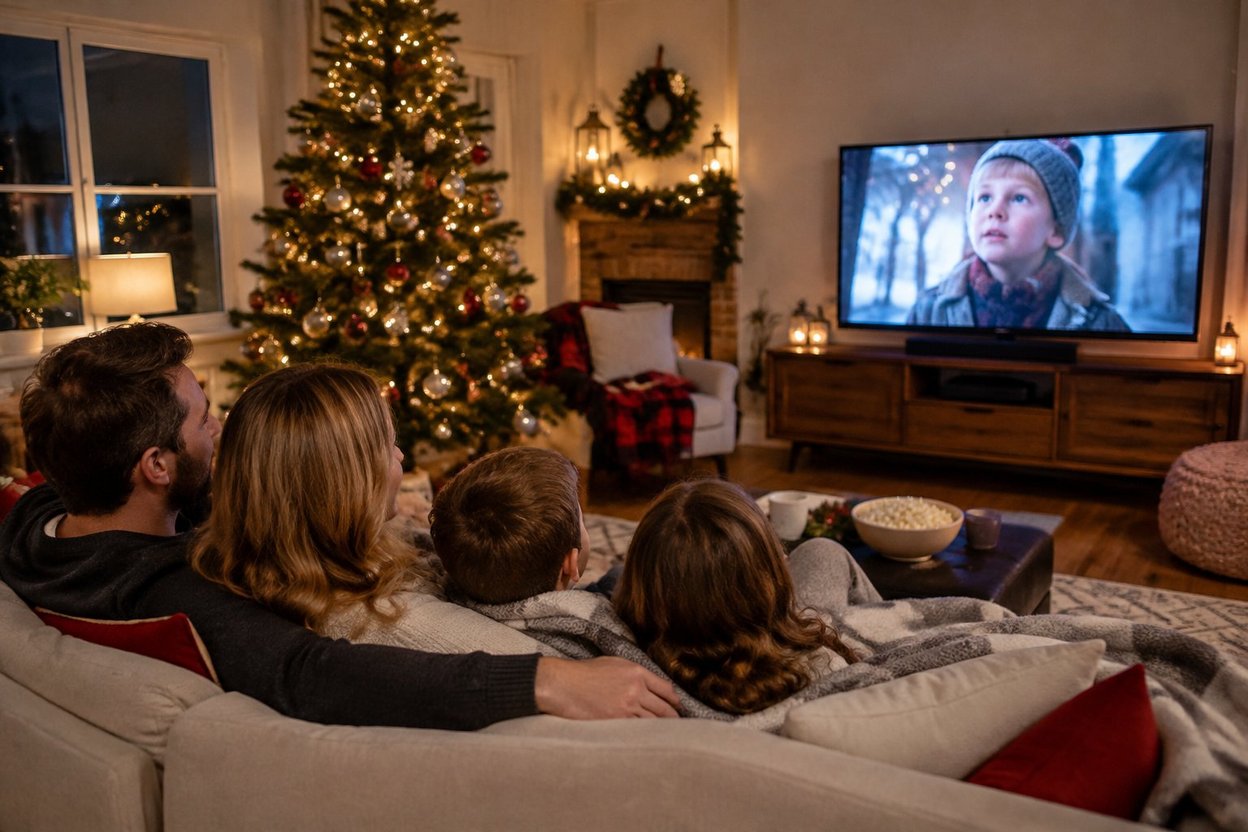
Why Do People Rewatch the Same Christmas Movies?
Why people keep rewatching Elf and Home Alone every December: the research on guaranteed comfort, nostalgia, connection and familiar company.
Halloween is still two weeks off, and some people already have Elf or Home Alone lined up for the day after Thanksgiving. You know every line. You know when Kevin gets out of the house and when Buddy shows up in the mailroom. You'll watch it anyway, maybe more than once. The short reason is that a familiar movie promises a feeling it reliably delivers, and the holidays are when many people most want comfort, connection and a link to their own past. Here's what research says about each of those pulls.
The short answer
Rewatching works because the payoff is certain. A new movie might disappoint you. A favorite one almost never does, because you already know what it will make you feel. December adds a second layer. The holidays are built around tradition, family and memory, which are the same things researchers find at the center of nostalgia and of people's sense of belonging.
One caveat matters. No study looks only at Christmas movies. The explanations below come from broader research on why people repeat experiences, what nostalgia does for people, and how favorite TV shows affect loneliness. Those findings fit the holiday habit well, but nobody has tested them on Rudolph or Die Hard in particular.
So this article does two things. It shows how common the habit is, and then it covers four research-backed reasons people return to the same stories: a guaranteed emotional payoff, a way to measure personal change, nostalgia's link to connection, and familiar characters as a kind of company.
How common it is
The habit is very common. In a Morning Consult/Hollywood Reporter poll of 2,200 US adults, taken November 14–17, 2019 (margin of error 2 points), 76% said they were likely to rewatch a holiday movie they watch every year. That poll is from 2019, so treat it as a snapshot, not a current count. It is still a clear majority.
The same poll asked which titles people liked most, and older classics came out on top:
- "Rudolph the Red-Nosed Reindeer": 83% favorable, the highest in the poll
- "A Charlie Brown Christmas": 82%
- The animated "How the Grinch Stole Christmas": 82%
- "Die Hard," the movie people argue about every year: 61% favorable, 12% unfavorable
Many viewers had also moved online. In 2019, 41% said they preferred to watch holiday films by streaming, and 21% each picked cable and broadcast. Whatever the screen, most people kept watching the same handful of stories, and the research below helps explain why.
You know what you're going to feel
The best-known study on repeat viewing comes from marketing researchers Cristel Russell, then at American University, and Sidney Levy of the University of Arizona. Their paper in the Journal of Consumer Research (2012) looked at what they called "reconsumption," meaning returning to a book, movie or place you've already experienced.
They ran open-ended interviews with 23 people who had recently repeated one of those experiences, then searched the transcripts for recurring themes. A clear one was that rewatching is a way of picking a "sure thing." People knew roughly what emotion they would get, whether laughter, excitement or relaxation, and that was the point.
That changes how to think about a holiday rewatch. Choosing Home Alone for the tenth time isn't a failure to find something new. It's a deliberate pick of a known feeling. On a stressful December night, after travel or shopping or family logistics, a guaranteed laugh can be worth more than a gamble on something new.
The researchers also expected boredom to come up, and it mostly didn't. Participants reported little to none. Russell explained this with a line from the Greek philosopher Heraclitus: "You never cross the same river twice." The movie stays the same, but the viewer doesn't, so each viewing feels a little different. That idea leads to the study's most surprising finding.
Rewatching as a way to measure yourself
If the viewer changes between viewings, the movie can show how much. In the Russell and Levy interviews, people used familiar stories, often without realizing it, as a yardstick for their own lives. Coming back to the same film showed them where they stood now compared with the last time.
One participant rewatched the Kevin Costner film Message in a Bottle several times while getting over a broken engagement. Each viewing reminded her of the relationship, and her changing reactions showed her she was moving on. "It was helping her work through having an engagement that hadn't worked out," Russell said.
Russell has said she expected nostalgia to be the main driver. Instead, she found people were "very forward-looking and prospective." She has said the rewatchers "weren't mainly chasing nostalgia," and that the experience "allowed them to appreciate how much they had grown." She calls it "an appreciation of the present."
Christmas movies are well suited to this, because many people watch them at the same time every year. The movie stays fixed while the viewer's life moves on: the year Elf was first watched with a new partner, or the first December Home Alone played for a child who had never seen it. Nostalgia still plays a role, though, and research suggests it does more than make people wistful.
Nostalgia and feeling connected
Psychologists used to treat nostalgia as a kind of homesickness, something close to a disorder. Modern research views it much more favorably. Constantine Sedikides and Tim Wildschut, who have studied nostalgia for years, argue that it helps people find meaning in life. It does this mainly by raising social connectedness, a sense of belonging and acceptance, and secondarily by strengthening self-continuity, the sense that your past self and present self are the same person.
Experiments support this. A 2011 paper by Clay Routledge, Wildschut, Sedikides and colleagues in the Journal of Personality and Social Psychology found that nostalgia was linked to a greater sense of meaning in life. When researchers prompted people to feel nostalgic, that sense of meaning went up. In both studies, feeling socially connected explained the effect. A 2019 follow-up by Wijnand van Tilburg and colleagues described a chain: nostalgia builds connectedness, which strengthens self-continuity, which in turn adds to meaning.
What people feel nostalgic about matters here. Nostalgic memories usually feature the self alongside close others or during momentous events. Reviews of the field list examples such as Thanksgiving dinners, weddings and graduations, and earlier work also found holidays, birthdays and reunions in people's nostalgic accounts. In other words, the holidays are one of the most common settings for nostalgia, and a movie watched every December connects to all of them.
This research is about nostalgia in general, not about Christmas movies. It does suggest that when the Grinch's heart grows three sizes, part of what a viewer feels is the people they first watched it with.
Familiar stories as company
Not everyone spends the holidays surrounded by family, and research on TV and loneliness suggests familiar stories help there too. Psychologists Jaye Derrick and Shira Gabriel of the University at Buffalo and Kurt Hugenberg of Miami University tested what they called the "social surrogacy hypothesis." The idea is that favorite shows can give people a sense of belonging when real company isn't available. Their work appeared in the Journal of Experimental Social Psychology and was covered by Scientific American in 2009.
Across several experiments, lonely participants were more likely to report watching a favorite show, and those who watched it felt less lonely. In another test, people who recalled a fight with someone close to them then wrote much longer essays about a favorite show than about one they didn't care for. After that kind of relationship threat, watching a favorite show protected people against drops in self-esteem and mood and against feelings of rejection.
The researchers were careful about what this means. They called their results "preliminary evidence." They also said it is an open question whether surrogacy just quiets the need to belong or actually meets it. Derrick warned that turning away from family and friends in favor of TV may be maladaptive. A favorite movie can be good company, but it works best alongside people, not in place of them.
The takeaway
Rewatching the same Christmas movies is normal: about three in four US adults said in 2019 that they were likely to do it. Research suggests it's usually healthy too. The reasons overlap. A familiar film guarantees a feeling, shows viewers how far they've come since last December, brings back memories of the people they shared it with, and keeps them company when those people aren't around. None of these studies looked at Christmas movies specifically, but together they explain the habit well. So when Thanksgiving is over and Elf goes back on, watching it again isn't a sign of being stuck.
Sources (12)
- Morning Consult: It's Beginning to Look a Lot Like Holiday Movie Season
- Scientific American: Why You Like to Watch the Same Thing Over and Over
- Pepperdine Graziadio: Cristel Russell on rewatching TV shows (Vox, 2023)
- Scientific American: Imaginary Friends
- University at Buffalo press PDF: Derrick and Gabriel, Imaginary Friends
- Tilburg University: How nostalgia infuses life with meaning from social connectedness
- Tilburg University repository listing
- University of Southampton ePrints: Routledge et al. 2011
- Sedikides & Wildschut: Nostalgia as a Wellspring of Meaning
- Van Tilburg, Sedikides, Wildschut & Vingerhoets, 2019, EJSP
- Wildschut et al.: Nostalgia: content, triggers, functions (record)
- Wildschut, Sedikides, Zengel & Skowronski, 2026, Cognition and Emotion