Can Two Parents Have a Child With a Different Blood Type?
Yes, and it's common. How ABO and Rh types pass from parents to kids, every parent combination, and the rare exceptions.
Yes. Two parents can have a child whose blood type matches neither of them, and it happens all the time. Two type A parents can have a type O child. An A parent and a B parent can have a child of any of the four ABO types. Two Rh-positive parents can have an Rh-negative baby.
This works because every parent carries two copies of the blood type gene and only passes one to each child. Your blood test shows only the result of your two copies. It doesn't show which copies you carry underneath.
This is plain genetics. It isn't medical advice. If a blood type result worries you, ask your doctor or the lab that ran the test.
How the ABO gene works
The ABO gene comes in three common versions, called alleles: A, B and O. You get one from your mother and one from your father.
A and B are both dominant over O. They are also codominant with each other, which means that if you get one of each, both show up. That gives you this:
- AA or AO = type A blood
- BB or BO = type B blood
- AB = type AB blood
- OO = type O blood
The hidden O is what causes surprises. A person who tests as type A might be AA, or might be AO and carry an O copy without ever knowing it. If two AO parents each pass on their O, the child is OO, and that's type O.
Every ABO combination, parent by parent
Here's what each pair of parents can have, under the standard rules. "Can have" means possible, not guaranteed for every child.
- O + O: O only
- O + A: A or O
- O + B: B or O
- O + AB: A or B (not O, not AB)
- A + A: A or O
- A + B: A, B, AB or O
- A + AB: A, B or AB
- B + B: B or O
- B + AB: A, B or AB
- AB + AB: A, B or AB
A few things stand out:
- A + B is the only pairing that can produce all four types. If the A parent is AO and the B parent is BO, each child has a 25% chance of A, B, AB or O.
- An AB parent and an O parent never have a child who is AB or O under the normal rules. Every child is A or B, so in this family the children will always differ from both parents.
- Two O parents can only have O children. Neither parent has an A or B copy to pass on.
So a child with a different type from both parents is nothing unusual. In the O + AB family it's guaranteed.
How the Rh factor (positive or negative) works
The plus or minus after your blood type comes from a separate gene, RHD, which sits on chromosome 1. It's inherited separately from ABO.
Rh-positive is dominant. You need only one working copy of RHD to be positive. Most Rh-negative people have no working copy at all. In many of them, the RHD gene is missing on both copies of chromosome 1.
That gives three possibilities for each parent: two working copies (positive), one working copy (positive, but carrying negative), or none (negative).
- Positive + positive: child can be positive or negative. If both parents carry one negative copy, each child has about a 25% chance of being Rh-negative and 75% of being positive.
- Positive + negative: child can be positive or negative. If the positive parent carries a negative copy, it's roughly 50/50 for each child.
- Negative + negative: child is negative.
This is how two O-positive parents can have an O-negative baby. Both parents carried a negative copy and both passed it on. For more on that side of the blood type, see our post on Rh-negative blood.
Putting both genes together
Your full blood type is the two results stacked: ABO letter plus Rh sign. Because the two genes are inherited separately, you work each one out on its own and then combine them.
Take an A-positive parent (AO, carrying one negative Rh copy) and a B-positive parent (BO, also carrying one negative Rh copy). Their children could be A+, A−, B+, B−, AB+, AB−, O+ or O−. That's all eight common blood types from one pair of parents.
That's an extreme case, but it shows how much is hidden behind a two- or three-character blood type.
The rare exceptions to the rules
The list above covers almost every family. A few rare conditions break it, which is why a "wrong" blood type in a family doesn't prove anything by itself.
Bombay phenotype. Your body needs a building block called the H antigen before it can make A or B markers. People who inherit two broken copies of the gene behind it (FUT1) can't make H, so they test as type O even if they carry A or B genes. They can then pass those A or B genes to a child, so an "O" parent can have an A or B child that the chart says shouldn't be possible. It's estimated at about 1 in 10,000 people in India and higher around Mumbai, and much rarer elsewhere.
Cis-AB. This is a rare version of the ABO gene that carries both A and B on a single copy. A person with it can be type AB and still pass on an O. That lets an AB parent have an O child, or an AB parent and an O parent have an AB child, both of which break the normal rules. It's been reported at about 1 in 80,000 people in Japan and turns up more often in parts of East Asia, especially Korea.
Chimerism and transplants. Some people carry two sets of DNA. Sometimes that's because fraternal twins swapped blood-forming cells in the womb. Someone like that can show a mixed or unexpected blood type. A bone marrow transplant can also change a person's blood type to the donor's, but that change is never passed on to their children.
Weak or variant Rh types. RHD has many variants, including some where the gene is present but doesn't work normally. Different lab methods can read these differently, so the same person can come back "positive" on one test and "negative" on another.
Why it matters outside of curiosity
In day-to-day life, blood type differences in a family mostly don't matter. The big exception is pregnancy. An Rh-negative mother carrying an Rh-positive baby can make antibodies against the baby's blood. That's why prenatal care tests the mother's blood type early on. This is called Rh disease, and it's preventable with standard care.
The second case is parentage. Blood type can rule out some combinations under the normal rules. But because of the exceptions above, it can't prove or disprove who a parent is. A DNA test is the right tool for that.
Quick ways to read your own family
- If both parents are O, every child should be O.
- If one parent is AB, no child should be O (cis-AB is the rare exception).
- If either parent is A or B, they may be carrying a hidden O.
- If both parents are Rh-positive, a negative child just means both carry a negative copy.
- If something still doesn't fit, ask for a retest before you draw any conclusions. Variants, lab methods and record errors explain most surprises.
Want to know how your type compares with everyone else's? See blood types ranked from most common to rarest, or read about golden blood, the rarest of them all.
Sources (6)
- How is blood type inherited? And do exceptions ever happen? (The Tech Interactive, Stanford-affiliated Ask a Geneticist)
- Beyond A, B, O: Why is our blood type positive or negative? (The Tech Interactive)
- How does cis-AB blood type work? (The Tech Interactive)
- Prevalence of Bombay blood group in a tertiary care hospital, Andhra Pradesh, India (PMC)
- RHD gene entry (OMIM)
- Rh Disease (Children's Hospital of Philadelphia)
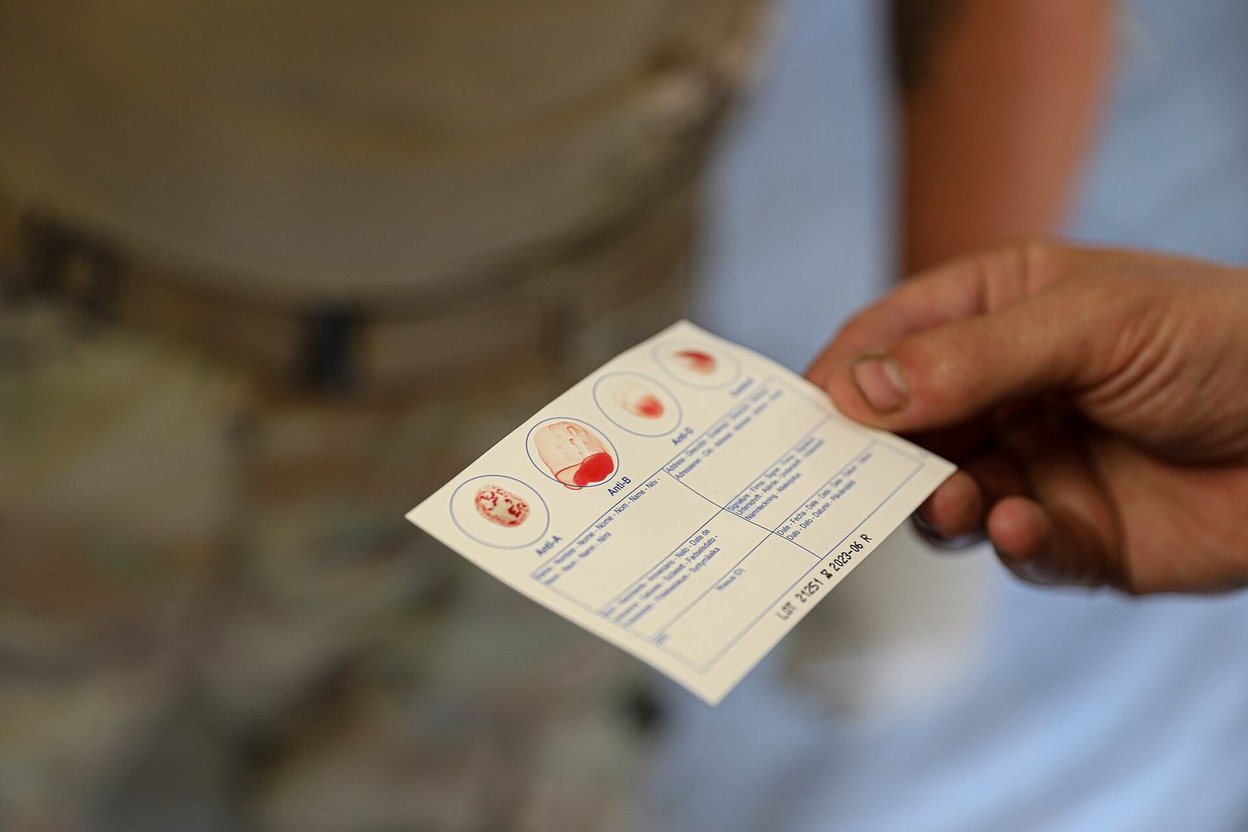
Photo: 64 BSB medics conduct walking blood bank training (7374077).jpg) by U.S. Army 113MPAD by Sgt. Tara Fajardo Arteaga, Public domain.