The Fascinating World of Fig Trees: Uncovering their Historical Significance, Biology, and Culinary Uses
Discover how figs are pollinated by a tiny wasp inside the fruit, why most figs skip that step, and what to know about eating and growing them.
You split a ripe fig with your thumbs and find a soft, pink interior packed with hundreds of tiny strands and specks. That interior is a bouquet of flowers turned inside out. In the wild, a wasp smaller than a grain of rice pollinates the fig from the inside. The figs you buy mostly skip that step thanks to a quirk humans have exploited since farming began. Here is how the fig works, why people have planted and revered it for millennia, and what to know before you eat one or grow one.
A flower cluster turned inside out
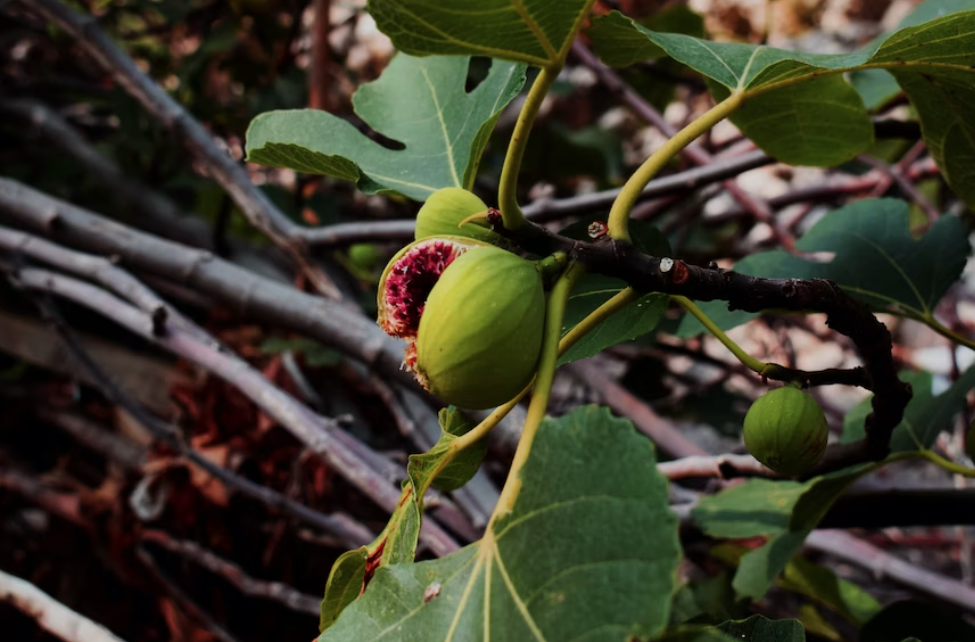
Botanically, a fig is not a single fruit or a berry. It is a syconium: a fleshy, hollow receptacle whose inner wall is lined with hundreds of tiny flowers, each either male or female. When those flowers are pollinated, each one develops into its own miniature fruit. That makes the fig both an accessory fruit, because most of what you eat is the swollen receptacle, and a multiple fruit, because it is built from many flowers.
The fig you eat comes from one species, Ficus carica, the common fig. It belongs to a huge genus. Ficus has roughly 750 to 850 species, from towering banyans and plants that grow on other trees to small deciduous shrubs. Within Ficus carica alone, the horticulturist Ira J. Condit documented more than 700 cultivated varieties.
The wasp that lives inside
Because the flowers are sealed inside, wind and bees cannot reach them. The common fig depends on a single pollinator, the fig wasp Blastophaga psenes. Neither can complete its life cycle without the other, a relationship biologists call an obligate mutualism.
A female wasp finds a young, unripe fig and pushes through a tiny opening at its tip called the ostiole. The passage is so tight that she loses her wings and antennae on the way in. Inside, she lays her eggs and spreads the pollen she carried from the fig where she hatched.
The common fig divides this work between two kinds of trees. Caprifigs act as the "male" trees. They carry pollen-bearing flowers and short-styled "gall" flowers where the wasps lay eggs and their young develop. Edible female trees carry only long-styled female flowers, which produce seeds when pollinated. Botanists call this arrangement gynodioecious, which in practice means the species behaves as if it had separate sexes.
Why most figs you eat skipped the wasp
Many commercial varieties, including 'Black Mission' and 'Brown Turkey', are parthenocarpic. They ripen into full, sweet fruit without caprification, the old practice of hanging caprifigs in the orchard, and without any insect pollination at all. For these varieties, the wasp was never part of the process.
This shortcut is ancient. At Gilgal I, a Neolithic village in the lower Jordan Valley, archaeologists found carbonized parthenocarpic figs dated to about 11,400 to 11,200 years ago. A fig that cannot be pollinated cannot reproduce from seed. These trees had to be grown from cuttings, which means people were deliberately propagating them. The find suggests that fig growing was already under way at the very start of agriculture.
Trees people treated as sacred
The habit of growing figs from cuttings shaped one of the most revered trees in the world. The Bo tree, Ficus religiosa, is the wild fig species linked to the Buddha's enlightenment at Bodh Gaya. Around 288 BCE, a cutting from that tree was planted at Anuradhapura in Sri Lanka. Today it is known as Jaya Sri Maha Bodhi and is still alive. It is the oldest living human-planted tree with a documented planting date.
The two figs are different species. The Bo tree is not the fruit tree in your yard. Both, however, show how long people have kept figs alive by planting pieces of them.
Where your figs come from today
In the United States, commercial fig growing is almost entirely a California business. The state grows roughly 98 to 100 percent of the country's commercial crop, mainly in Fresno, Madera, and Merced counties. Much of that crop is dried. The California Fig Advisory Board runs the industry under the state's Marketing Order for Dried Figs, which was set up under the California Marketing Act of 1937. At the federal level, the USDA's Agricultural Marketing Service publishes voluntary grade standards for dried figs.
Growers also face pests. California's Department of Food and Agriculture has regulatory and quarantine authority to eradicate the invasive black fig fly (Silba adipata), which infests both commercial orchards and backyard trees.
Eating figs: what you get, and one caution
According to USDA FoodData Central, 100 grams of raw fig provides about:
- 74 kcal
- 2.9 g of dietary fiber
- 232 mg of potassium
- 35 mg of calcium
As for how to eat them, that is a matter of taste rather than fact. A ripe fresh fig needs little more than a knife. Many people pair figs with cheese, tear them into salads, or reach for dried figs when fresh ones are out of season.
There is one medical note. Figs contain moderate amounts of vitamin K. If you take an anticoagulant such as warfarin, doctors advise keeping your intake of foods like figs consistent from week to week, so your INR blood test results stay stable.
Before you plant one
If figs make you want a tree of your own, keep two things in mind.
First, the sap in fig leaves and green shoots contains furocoumarins, such as psoralens. If sap gets on your skin and the skin is then exposed to sunlight, it can cause phytophotodermatitis, a burn-like skin reaction. Wear gloves and long sleeves when you prune, and wash off any sap before going out in the sun.
Second, the common fig is not native to the United States. In parts of California it has escaped cultivation and spread along waterways, where it can crowd out native plants. A tree in a garden is fine, but keep it from seeding wild areas, particularly if you live near a creek.
Hidden flowers, a wingless wasp, figs grown from cuttings at the dawn of farming, and a sacred tree planted more than two thousand years ago all come together in that soft fruit you split with your thumbs.
Sources (24)
- Syconium – Wikipedia
- Ficus – Wikipedia
- Ficus – Trees and Shrubs Online
- HortScience article on fig cultivars
- Common fig – Wikipedia
- Fig – California Rare Fruit Growers
- Caprifig – Britannica
- UC ANR blog on figs
- Blastophaga psenes – Wikipedia
- Fig wasp – Britannica
- Figs likely first domesticated crop – Harvard Gazette
- Ancient figs – ScienceDaily
- Jaya Sri Maha Bodhi – Wikipedia
- Figs – Agricultural Marketing Resource Center
- California Figs
- California Fig Marketing Order – CDFA
- Black fig fly profile – CDFA
- Dried Figs Grades and Standards – USDA AMS
- USDA FoodData Central
- Phytophotodermatitis – DermNet
- Phytophotodermatitis case report – PMC
- Warfarin and Vitamin K – Cleveland Clinic
- Ficus carica plant profile – USDA PLANTS
- Ficus carica datasheet – CABI